Summary:
You received the ashes. Maybe it’s been a few weeks. Maybe longer. And you still don’t quite know what to do with them — not because you haven’t thought about it, but because no one handed you a clear map of your options when you needed one most.
That’s more common than you’d think. Cremation is now the majority choice in the U.S., but the guidance families receive afterward rarely matches the weight of the decision. This guide is here to change that. We’ll walk through every meaningful option — plainly, without pushing you toward any one answer — so you can move forward with confidence instead of uncertainty.
Options for Ashes After Cremation: The Full Picture
Most families assume they’re choosing between two things: keep the ashes at home or scatter them somewhere. The reality is that there are at least seven distinct paths, each with its own emotional character, practical requirements, and long-term meaning.
Knowing all of them matters — not just so you can pick one, but because some families choose more than one. Splitting cremated remains between a sea scattering and a keepsake portion kept at home, for example, is entirely legal and increasingly common. There’s no rule that says you have to do just one thing.
Disposal of Ashes After Cremation: What Each Option Actually Involves
Here’s an honest look at the most meaningful options families in Nassau County choose from, and what each one actually requires of you.
Keeping ashes at home is the most common first choice. The ashes are returned in a temporary container from the funeral home, and many families transfer them to a permanent urn. There’s no legal deadline to act further — in New York, you’re not required to place remains in a cemetery or scatter them within any set timeframe. For some families, keeping the ashes close is the right long-term answer. For others, it’s a temporary holding pattern while they figure out next steps.
Ground interment at a cemetery is the closest equivalent to traditional burial. A cremation plot or niche in a cemetery lawn allows for a permanent, marked location that family members can visit. Some cemeteries offer cremation gardens specifically designed for this purpose. The permanence is meaningful to many families, particularly those with strong ties to a specific faith community or a family burial plot they want to remain part of.
A columbarium niche is an above-ground option offered by many cemeteries and some churches throughout Nassau County. The urn is placed in a small, sealed compartment within a columbarium wall, often indoors or in a sheltered outdoor structure. It offers the same “place to return to” quality as ground interment, with a slightly different physical form. For Nassau County families with ties to a local parish, this can be a spiritually grounded choice.
Memorial reefs are a newer option that’s grown significantly in recent years. Cremated remains are mixed into an artificial reef structure and placed on the ocean floor, where they become part of a living marine habitat. It’s a permanent, documented location — families receive GPS coordinates — and it appeals strongly to those who want an environmentally meaningful final placement.
Cremation jewelry and memorial keepsakes allow a small portion of ashes to be incorporated into wearable items — pendants, rings, or glass art. This is often chosen alongside another primary option, not instead of one, and gives individual family members something tangible to hold onto.
Green burial for cremated remains involves scattering ashes in a natural setting — a forest, meadow, or body of water — often with a biodegradable urn that allows remains to integrate naturally into the earth. Regulations vary by location, so it’s worth checking local rules before choosing a specific site.
Sea scattering is the option we know best. Cremated remains are released into the ocean during a ceremony — either with family present aboard a vessel, or carried out by our professional crew on your behalf. It’s the only option on this list that is also an experience: a journey, a gathering, a moment that families consistently describe as unexpectedly beautiful.
How Do You Know Which Option Is Right for Your Family?
There’s no universal answer, but there are a few questions worth sitting with. Did your loved one have a connection to the ocean, to nature, to a particular place? Would they have wanted a ceremony — something that gathers the people who loved them — or would they have preferred something quiet and private? Does your family need a fixed location to return to, or would the knowledge of coordinates and an open horizon feel like enough?
Cost is a factor too, though it rarely ends up being the deciding one. What tends to matter more is whether the choice feels right — whether it reflects who the person was and gives the people left behind a genuine sense of closure.
One thing worth knowing: you don’t have to decide everything at once. Many families keep the ashes at home while they work through the decision, and that’s completely reasonable. What tends to shift the timeline is a gathering — a moment when the family is together and the conversation finally happens naturally. If you’re in that window right now, this guide is meant to help that conversation go somewhere.
It’s also worth naming a concern that comes up often: the worry that scattering ashes means losing them, or losing the ability to visit. That’s understandable. But for sea scattering specifically, families receive the GPS coordinates of exactly where the ceremony took place. The ocean doesn’t move. You can always return to those waters. And many families choose to keep a small portion of remains in a keepsake urn precisely so that something tangible stays close, even after the ceremony.
The bottom line is that there are more options than most families realize, and most of those options can be combined. The decision doesn’t have to be all-or-nothing.
Places to Put Cremation Ashes: Why Nassau County Families Choose the Sea
Nassau County sits on Long Island’s South Shore, bordered by the Atlantic Ocean. Communities like Long Beach, Atlantic Beach, Lido Beach, and Point Lookout have a deep, lived relationship with these waters — not as an abstraction, but as a place people have spent their lives. For many families here, the idea of returning a loved one to the ocean isn’t foreign. It’s familiar.
That cultural connection is part of why sea scattering resonates so strongly in Nassau County. The other part is what the ceremony itself actually looks and feels like — which is something most people don’t fully understand until they’ve experienced it.
What Does a Sea Burial Ceremony Actually Look Like?
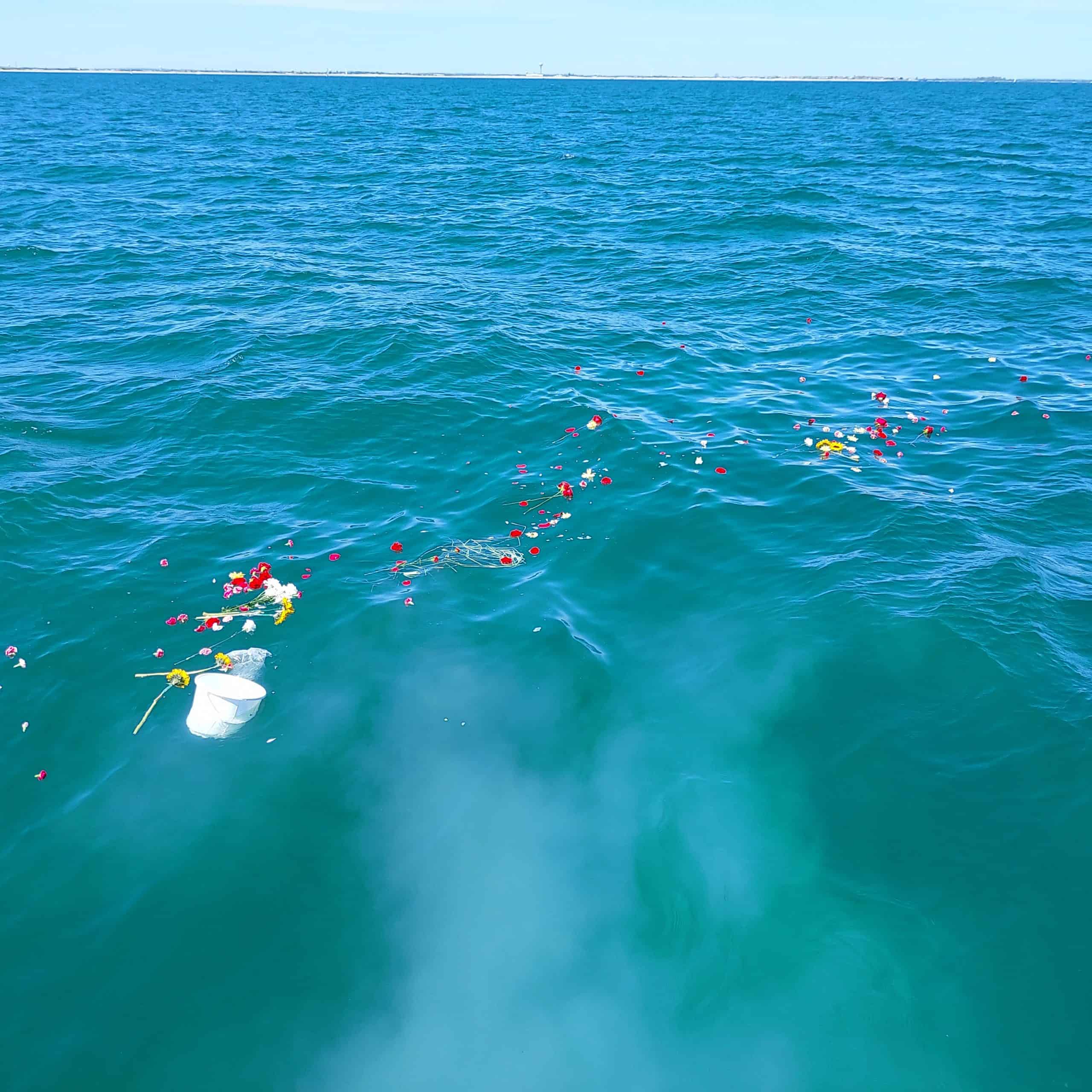
There are two ways to approach a sea burial. The first is an attended ceremony, where family and guests board a vessel together and accompany the ashes to sea. The second is an unattended service, where our professional crew carries out the scattering on your behalf and provides documentation — including GPS coordinates — of the final resting place.
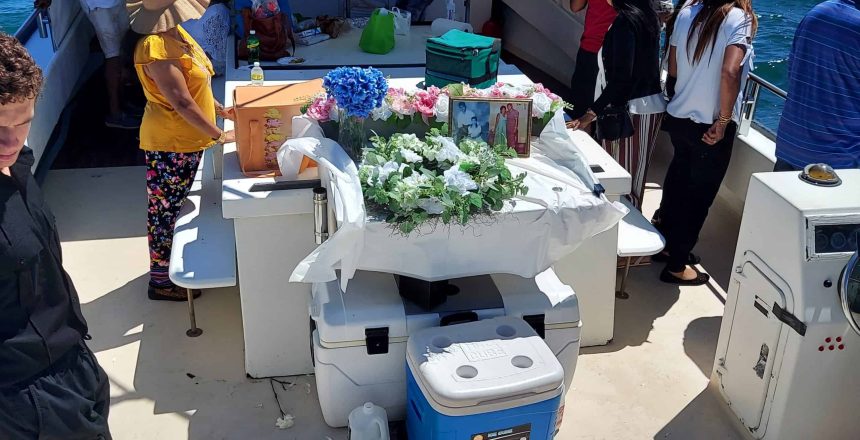
Both are meaningful. The attended ceremony is the one that tends to stay with people. Families board the vessel together, often with music playing, sometimes with a priest or other officiant present for prayers and religious rites. The vessel travels out to sea — under EPA regulations, at least three nautical miles from shore — and the ceremony takes place on the water. The ashes are released. People grieve together, in a setting that is open and beautiful and completely unlike a funeral home.
We conduct our ceremonies off the coast of Point Lookout, departing from Freeport’s marina at 1 Anchorage Way — a location most Nassau County residents know well. The Nautical Mile is a beloved part of the South Shore, and for many families, the drive to the marina is itself a familiar, grounding experience before the ceremony begins.
Our vessel, the *Seaspray*, is Coast Guard-inspected and sits low in the water — which matters more than it might sound. The low deck makes the physical act of releasing the ashes natural and accessible, even for elderly guests or those with limited mobility. The vessel also has a heated cabin, which means ceremonies can take place year-round. Grief doesn’t follow a seasonal schedule, and neither do we.
Families are welcome to bring their pets aboard. Catering is available for those who want to hold a proper gathering at sea — breakfast, lunch, dinner, drinks. A priest can be present for religious rites if that’s important to your family. The ceremony can include personalized music, themed decorations, or any elements that reflect who your loved one actually was. The goal is that the ceremony feels like them, not like a generic farewell.
Is Sea Scattering Legal in New York, and Who Handles the Paperwork?
This is one of the most common questions families ask, and the answer is straightforward: yes, scattering cremated remains at sea is entirely legal in U.S. waters, including off the coast of Nassau County, NY, under a general permit issued by the EPA under the Marine Protection, Research, and Sanctuaries Act.
The rules are specific. The scattering must take place at least three nautical miles from shore. Within 30 days of the ceremony, the responsible party must notify the EPA using their Burial at Sea Reporting Tool. For cremated remains, there is no minimum water depth requirement — that rule applies only to whole-body burial at sea.
We handle all of this on your family’s behalf. You don’t need to become familiar with maritime law or EPA reporting systems in the middle of a period of grief. Our team coordinates all necessary permits, ensures full compliance with federal regulations, and manages the post-ceremony reporting. All you need to bring is the cremated remains, a copy of the death certificate, and the people you want present.
Master Captain Scott Schafer holds a USCG Master Captain credential — the highest level of civilian maritime certification — and has navigated these waters extensively. Burial Coordinator Maria Brusalis is your primary point of contact throughout the planning process. You’ll work with named, real people from the first conversation to the day of the ceremony. That matters when you’re making a decision this significant.
For Nassau County families specifically, the logistics are genuinely straightforward. The departure point at Freeport is accessible from throughout the county, and the Atlantic waters off Point Lookout are reached quickly. This isn’t a distant or complicated undertaking. It’s a ceremony that begins close to home and ends somewhere that stays with you.
What Do People Do With Ashes? The Answer That Actually Fits
There’s no single right answer to what you should do with cremated remains — but there is a right answer for your family, and it usually becomes clearer once you understand the full range of options. Most people don’t. They receive the ashes, feel the weight of the decision, and quietly set it aside until the moment feels right.
If this guide has helped that moment feel a little closer, that’s exactly what it was meant to do. Whether you’re drawn to a sea ceremony, a cemetery niche, a keepsake urn, or some combination of all three, the most important thing is that the choice reflects who your loved one was and gives your family something real to hold onto.
If a sea burial feels like it might be the right fit — for the person you lost, for your family, for the waters you’ve grown up alongside on the South Shore — we’d be glad to talk it through with you. Reach out to Eternal Peace Sea Burials at 631-668-5800. There’s no pressure and no rush. Just an honest conversation about what’s possible.