Summary:
Most families who start researching burial at sea have the same first question: is this even legal? The short answer is yes — and it’s more accessible than most people expect. But there’s a lot of misinformation out there, and the process is specific enough that doing it wrong isn’t just embarrassing — it’s a federal violation.
This guide covers what burial at sea actually involves, what the law requires, what a real ceremony looks like, and what it typically costs. If you’re in Queens County or anywhere on Long Island, we’ve also included details specific to this area — because a lot of what you’ll find online is written for a completely different coast.
Sea Burial Laws: What's Legal, What's Not, and Who's Responsible
Burial at sea in the United States is governed by the Marine Protection, Research, and Sanctuaries Act — the MPRSA — and administered by the EPA under 40 CFR 229.1. The regulation sounds dense, but the practical requirements are straightforward. Cremated remains must be scattered at least 3 nautical miles from the nearest shoreline. Full-body burials require that same 3-mile distance plus a minimum ocean depth of 600 feet. If you’re considering an unattended service, learn more about the process on our unattended sea burials page.
No permit application is required before the service. What is required is that someone files a notice with the EPA within 30 days after the ceremony, including the name of the deceased, the date and GPS coordinates of the scattering, and the vessel and operator information. We handle this filing for you — it should never fall on a grieving family to track down a federal form.
Environmental Regulations for Scattering Ashes at Sea
The EPA’s rules aren’t just about distance — they also govern what can and can’t go into the water. Only biodegradable materials are permitted. That means natural flowers, biodegradable wreaths, and urns designed to dissolve in seawater. Plastic flowers, metal containers, synthetic ribbons, and non-dissolving urns are all prohibited. This isn’t a technicality — it’s a federal restriction, and violating it can result in fines.
This is one area where the choice of provider matters more than most families realize. A licensed, experienced operator will know exactly what’s allowed and will either provide compliant materials or advise you clearly on what to bring. We provide biodegradable urns as part of our service — families don’t need to source their own or worry about whether what they’ve ordered meets the standard.
One thing worth clarifying: the EPA general permit covers human remains only. Pet ashes are not covered under the same federal authorization. If you’re considering a pet sea burial, ask your provider directly how they handle compliance for that service — it’s a legitimate question and a good way to gauge whether they know what they’re doing.
The 30-day EPA reporting requirement is the piece most families don’t know about until after the fact. When you work with a Coast Guard Master licensed captain operating a properly documented vessel, that filing is handled as a matter of course. Without proper credentials, there’s no guarantee the report gets filed at all — and that means there’s no official record that the ceremony ever happened.
Charter Boats for Scattering Ashes: What to Look for Before You Book
Not every boat that offers ash scattering is equipped — or qualified — to do it properly. There are unlicensed operators who offer discount services with no meaningful credentials, no EPA reporting, and no accountability. Families who use them often have no way of knowing whether the ceremony was conducted correctly, or at all.
The most important credential to ask for is a US Coast Guard Master license. This is the highest civilian maritime certification available — it requires documented sea hours, rigorous federal examinations, and ongoing renewal. It is not a recreational boating license. Our captain, Master Captain Scott Schafer, holds a USCG Master license. The Seaspray, the vessel we use for all ceremonies, is also Coast Guard-inspected — a separate certification that confirms the vessel meets federal safety standards for carrying passengers.
Beyond credentials, the vessel itself matters. A boat that sits low in the water makes the physical act of releasing ashes feel natural and close — not awkward or rushed. The Seaspray is specifically suited for this. It also has a heated cabin, which matters more than most people initially think. In Queens County and across Long Island, the weather from October through March can be cold and unpredictable. We operate year-round — because families don’t get to choose when they lose someone.
Ask any provider you’re considering: Is your captain USCG Master licensed? Is your vessel Coast Guard-inspected? Do you file the EPA report on our behalf? Do you provide a certificate with GPS coordinates? Those four questions will tell you most of what you need to know.
Scattering Ashes at Sea: What the Ceremony Actually Looks Like
Most people have a vague image of what a sea burial looks like — someone standing at the back of a boat, releasing ashes into the wind. The reality is both simpler and more meaningful than that. A well-run ceremony feels like a genuine farewell, not a boat ride with a task attached.
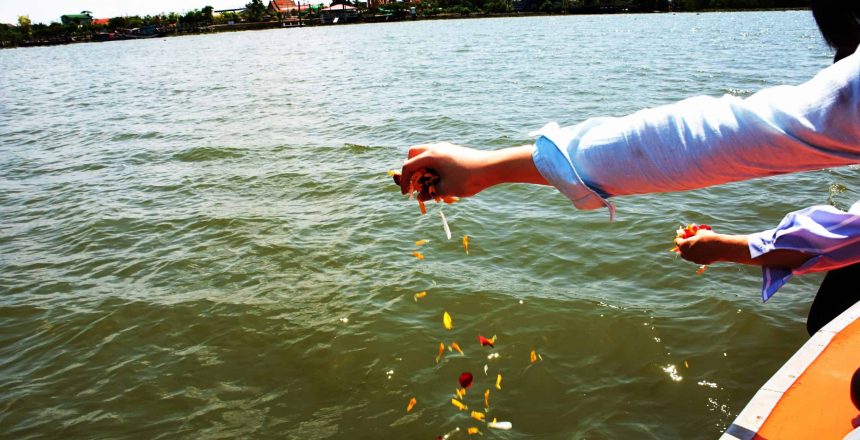
Your family boards the vessel, our captain and crew take you offshore to the designated area — at least 3 nautical miles out — and the ceremony unfolds at whatever pace your family needs. There’s room for music, readings, prayer, flowers on the water, and quiet. Some families bring a priest. Some bring a playlist. Some stand in silence. All of it is valid, and all of it can be accommodated.

One of the first decisions families face is whether to be present for the ceremony. Both options are legitimate, and the right choice depends entirely on your circumstances.
An attended service means you and your family board the vessel and participate directly. You’re there for the release, for the moment, for each other. These ceremonies can be as simple or as personalized as you want — music playing through the speakers, a short reading, flowers placed on the surface of the water, a moment of silence before the captain turns the boat back toward shore. Families who have attended these services often describe them as the most meaningful goodbye they’ve ever been part of.
An unattended service is when our captain and crew conduct the ceremony on your behalf, without passengers. This is a practical option for families spread across different states, or for those who aren’t physically able to make the journey, or who simply prefer a quieter arrangement. The ceremony is still conducted with care and documentation — you receive a certificate with the exact GPS coordinates of where the ashes were scattered, and the EPA report is filed on your behalf. Some families find real comfort in knowing there’s a specific location on a map that belongs to their loved one.
The ashes themselves, when scattered properly from a low-deck vessel like the Seaspray, largely sink beneath the surface. They don’t simply float. Cremated remains are denser than water, and when released at the surface, they disperse and descend. It’s a detail that matters to a lot of families who worry about what the moment will look and feel like.
Biodegradable Urn for Burial at Sea: What They Are and Why They're Required
A biodegradable urn is exactly what it sounds like — an urn designed to dissolve in seawater, releasing the cremated remains beneath the surface rather than on it. They’re typically made from materials like compressed salt, sand, or natural paper, and they dissolve within minutes to a few hours depending on the material and the conditions.
Under EPA regulations, any urn placed in ocean waters must be biodegradable. A standard ceramic or metal urn is not compliant. This is a detail that catches families off guard, particularly those who have already purchased an urn from a funeral home without knowing the restriction. If you’re planning a sea burial, it’s worth confirming with whoever you purchased from whether the urn meets the EPA standard before the day of the ceremony.
We provide biodegradable urns as part of our service. Your family doesn’t need to research this, source one separately, or worry about arriving at the marina with something that can’t go in the water. It’s one less thing to figure out during an already difficult time.
For families who have a meaningful urn they want to keep — one that belonged to the deceased, or one that was a gift — the ashes can be transferred to a biodegradable urn for the ceremony, and the original urn returned to your family. That’s a conversation worth having with your burial coordinator early in the planning process. Our burial coordinator, Maria Brusalis, handles exactly these kinds of details and can walk you through every option before you commit to anything.
Navy Veteran Burial at Sea: Military Honors in Queens County
The US Navy offers a free burial at sea for eligible veterans — active duty, retired, and honorably discharged — but the service is performed during a ship’s deployment at sea. Families cannot attend, and documentation is delivered only after the ship returns.
For Queens County veteran families who want to be present, who want military honors conducted on their timeline, and who want a GPS certificate marking their loved one’s final resting place, a civilian attended ceremony is often the more meaningful choice. We offer military honors as part of our ceremony options and have served many veteran families throughout the borough. Our captain can coordinate flag folding, rifle salutes if permitted, and the full dignity that a veteran’s service deserves — with your family present to witness it.