Summary:
There’s a narrow window every year when the Atlantic off Long Island’s South Shore becomes something genuinely special. The summer crowds thin out. The afternoon thunderstorms settle down. The light drops lower on the horizon, and the water takes on a quality that’s hard to describe but impossible to miss once you’ve seen it.
For families in Nassau County planning a memorial at sea, that window is September and October. And it closes faster than most people expect. If you’re thinking about a fall ceremony — for a loved one, for a veteran, for someone who always felt most at home near the water — here’s what you need to know before the season fills up.
Why Fall Is the Best Time for a Memorial at Sea in Nassau County
Summer gets all the attention, but experienced boaters on Long Island’s South Shore will tell you that early fall is when the water is actually at its best. The recreational traffic drops off after Labor Day. The sea conditions stabilize as summer’s thermal-driven afternoon storms give way to steady high-pressure systems. The air is clear in a way it simply isn’t in July or August.
For a memorial at sea, these things matter more than people realize. A ceremony held in calm, quiet conditions — without the chop of a busy summer waterway or the noise of passing boats — gives families the space to breathe, to be present, to let the moment mean what it’s supposed to mean.
What the Weather and Sea Conditions Actually Look Like in September and October
Early September off the South Shore still carries the character of summer — warm air, light southwest breezes, and seas that tend to run gentle in the mornings. It’s the kind of day that reminds you why people love being on the water here.
By mid-to-late September, the pattern shifts. Northerly winds start making appearances, the humidity drops, and the air takes on that clean, sharp quality that Long Island locals associate with the best days of the year. October is different again — fewer boats on the water, more stillness, and a quality of light that photographers and fishermen both talk about. The sun sits lower in the sky, and when it catches the Atlantic surface in the afternoon, the effect is genuinely striking.
Water temperatures in the fall range from the upper 70s in early September down through the 60s and into the 50s by late October. Air temperatures across Nassau County’s South Shore communities — Freeport, Oceanside, Long Beach, and Merrick — typically run from the mid-60s to low 70s in September and the mid-50s to low 60s in October. Comfortable, in other words.
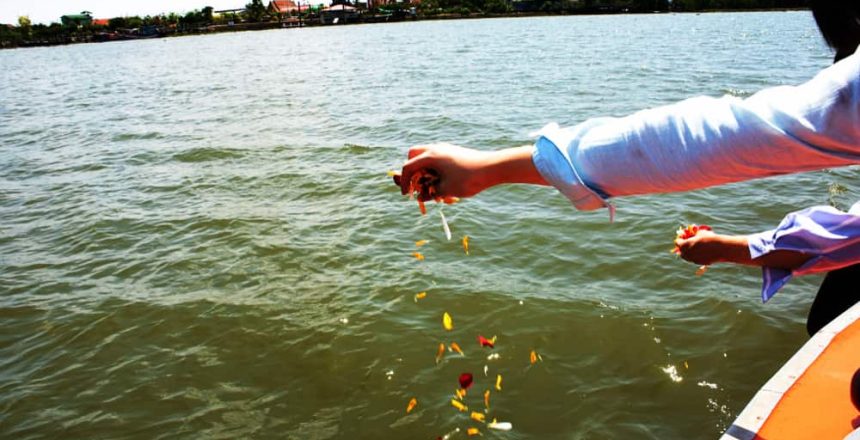
That’s one reason we built the Seaspray with a heated cabin. A fall ceremony isn’t something families have to endure — it’s something they can actually settle into. You can step outside for the ash release, take your time, and then come back inside without anyone feeling rushed or cold. Most local providers don’t offer that. Some of them aren’t even operating by October.
One concern families sometimes raise is hurricane season, which technically runs through October. Direct impacts on Long Island are rare. The more common scenario is a brief period of unsettled seas before or after a storm passes well offshore. We reschedule any ceremony when conditions aren’t right — that’s standard practice, and it’s something we communicate clearly upfront. The goal is always a ceremony that feels peaceful, not one that gets pushed through in marginal weather.
Why Fall Availability Closes Faster Than Families Expect
Fall is our documented peak season. Families who’ve done their research — or who’ve heard from someone who attended a September or October ceremony — know that this is the time to go. The problem is that knowing fall is ideal and actually booking in time are two different things.
We operate a single vessel, the Seaspray, with a dedicated crew. There are only so many ceremony slots available in a given September or October. When families wait until late September to start making calls, they often find that the best dates are already spoken for. October availability fills quickly too.
The families who get the ceremony they want — the specific Saturday in October, the morning departure, the date that works for everyone flying in — are the ones who called in August or early September. If you’re reading this in the summer and thinking “we should probably do this in the fall,” that instinct is right. The time to act on it is now, not in a few weeks.
Reaching out to our burial coordinator Maria Brusalis to ask about availability costs nothing and takes five minutes. Waiting until October and finding out the window has closed is a much harder conversation.
There’s also a practical consideration for families coordinating travel. When out-of-town family members need to book flights, hotels, and time off work, they need a confirmed date well in advance. Locking in a fall ceremony in August gives everyone the runway they need to actually be there.
Burial at Sea for Veterans: Why Fall Is a Meaningful Time to Honor Military Service
Veterans Day falls on November 11th. The weeks leading into it — October especially — carry a particular weight for families who lost someone who served. There’s a natural pull toward honoring that service in the fall, and a sea burial is one of the most fitting ways to do it.
The U.S. Navy does offer burial at sea for eligible veterans, but there’s a significant limitation that most families don’t learn about until they’ve already started the process: family members cannot attend the Navy’s ceremony. It’s conducted by the ship’s crew, on a schedule that serves the Navy’s operational needs, and the family receives a certificate afterward. For some families, that’s acceptable. For many, it isn’t.

Who Qualifies for a Private Veteran Sea Burial — and What It Actually Includes
A private sea burial through Eternal Peace Sea Burials is a fundamentally different experience from the Navy’s program. It’s attended — meaning the family is there. It’s scheduled around the family’s timeline, not a ship’s deployment schedule. And it can be personalized in ways that a government-run ceremony simply cannot accommodate.
Veteran eligibility for burial at sea is broader than most families realize. Active duty members of the uniformed services qualify, as do honorably discharged retirees and veterans. U.S. civilian marine personnel of the Military Sealift Command are eligible, and so are dependent family members of any of the above. If you’re not sure whether your loved one qualifies, that’s worth a direct conversation — the answer is often yes.
A private veteran ceremony aboard the Seaspray can include military honors, religious rites with a priest present if the family wishes, personalized music, and whatever other tributes feel right. Families from Nassau County’s veteran communities — and there are many, across Freeport, Massapequa, Rockville Centre, and throughout the South Shore — have chosen this option specifically because it gives them control over the ceremony that the Navy’s program doesn’t.
The fall timing adds another layer of meaning. Holding a veteran’s memorial at sea in October, with Veterans Day approaching, feels intentional in a way that a mid-July ceremony doesn’t. The season itself carries a sense of reflection and tribute that aligns with what these families are trying to do. The quieter ocean, the lower light, the absence of summer’s noise — it all contributes to a ceremony that feels like it was designed for the moment, not squeezed into a busy calendar.
Nassau County has a strong tradition of honoring military service. VFW and American Legion posts are active throughout the county, and many families in South Shore communities have deep personal connections to that legacy. A fall sea burial — attended, personalized, held off the coast of Point Lookout with the family gathered on deck — is a way of honoring that legacy in a setting that feels genuinely worthy of it.
Eco Friendly Burial: What Makes a Sea Burial Genuinely Green
More families are asking this question than ever before, and they deserve a straight answer rather than vague reassurances about returning to nature. Here’s what the numbers actually look like.
Traditional burials in the United States collectively use over 4.3 million gallons of embalming fluid annually, including 800,000 gallons of formaldehyde. They consume 20 million board feet of hardwood, 100,000 tons of steel, and 1.6 million tons of reinforced concrete — every year. A sea burial produces none of that. The cremated remains are released into the ocean at least three nautical miles offshore, as required by federal EPA regulations. The only materials that enter the water are the ashes themselves and, if used, a biodegradable urn that breaks down naturally.
Research from the Green Burial Council puts the climate impact of traditional burial at roughly 12 times that of a green burial. That gap is significant, and it’s one reason why the green funerals market has grown to $2.3 billion and is projected to reach $6.7 billion by 2034. This reflects a genuine shift in how people think about end-of-life choices.
For families where environmental values were important to the person being honored, a sea burial isn’t just a logistical alternative to a casket. It’s a final act that reflects how they actually lived. We handle all EPA compliance and post-ceremony reporting on behalf of the family — there’s nothing you need to file or track yourself. Every ceremony is fully documented, and families receive a memorial certificate that includes the date, time, and GPS coordinates of the scattering location.
The biodegradable urn option is available for families who want the ashes released gradually rather than scattered directly from the vessel. All materials used must meet EPA standards, which means nothing non-decomposable enters the water. We take that seriously, both because it’s the law and because it’s the right way to do this.
For Nassau County families, the waters off Point Lookout — where our ceremonies take place — are the same Atlantic waters that generations of South Shore residents have fished, swum in, and loved. Choosing a sea burial in these waters isn’t abstract environmentalism. It’s a deeply local act of returning someone to a place that was genuinely part of their life.
How to Plan a Fall Memorial at Sea in Nassau County
The case for a fall ceremony is straightforward: calmer seas, comfortable temperatures, meaningful light, and a quieter ocean that gives families the space a memorial deserves. September and October are the best months for this, and the families who get the dates they want are the ones who plan ahead.
If you’re considering a memorial at sea this fall — whether for a loved one, a veteran, or someone who simply felt at home near the water — the right time to reach out is now. Not because we’re trying to rush you, but because fall availability is genuinely limited and the season moves faster than it looks from a distance.
Eternal Peace Sea Burials is based at 1 Anchorage Way, Slip A23, on Freeport’s Nautical Mile. You can reach us at 631-668-5800. Our burial coordinator Maria Brusalis handles all scheduling, answers questions about veteran eligibility, and can walk you through exactly what a fall ceremony looks like from start to finish. There’s no pressure in that conversation — just information, and a real person who understands what you’re going through.