Summary:
There’s a particular kind of weight that settles in when the holidays arrive and you haven’t yet said a proper goodbye. The ashes are home. The calendar keeps moving. And somewhere in the back of your mind, you’re wondering whether a meaningful ceremony is even possible — or whether you have to wait until the weather warms up to do something that actually feels right.
You don’t. And if your loved one wasn’t religious, you don’t have to fit their memory into a framework they never believed in, either. Here’s what a non-religious funeral service actually looks like, and why Nassau County families are increasingly finding their answer on the water.
What Is a Non-Religious Funeral Service?
A non-religious funeral service is exactly what it sounds like — a ceremony that honors a person’s life without prayers, hymns, scripture readings, or religious doctrine of any kind. No church setting required. No officiant speaking on behalf of a faith the deceased never practiced.
What replaces those elements is something more personal. Music the person actually loved. Words spoken by the people who knew them best. A setting chosen for meaning rather than convention. The absence of religion isn’t a subtraction — it’s an opening for something more honest.
These services go by a few different names. You might hear “secular funeral,” “humanist funeral,” or “celebration of life.” The format varies, but the intention is the same: to mark the end of a life in a way that reflects who that person genuinely was.
Who Leads a Non-Religious Funeral, and What Does the Ceremony Look Like?
One of the most common questions families ask is who’s actually in charge of the ceremony if there’s no priest or pastor involved. The answer is more flexible than most people expect.
A secular celebrant or humanist officiant is a trained professional who specializes in non-religious ceremonies. We work with families beforehand to understand who the person was — their personality, their passions, the stories worth telling — and we build the ceremony around that. Some families choose to have a close friend or family member lead the service entirely. Others prefer a more structured format with a professional at the helm. Both are valid.
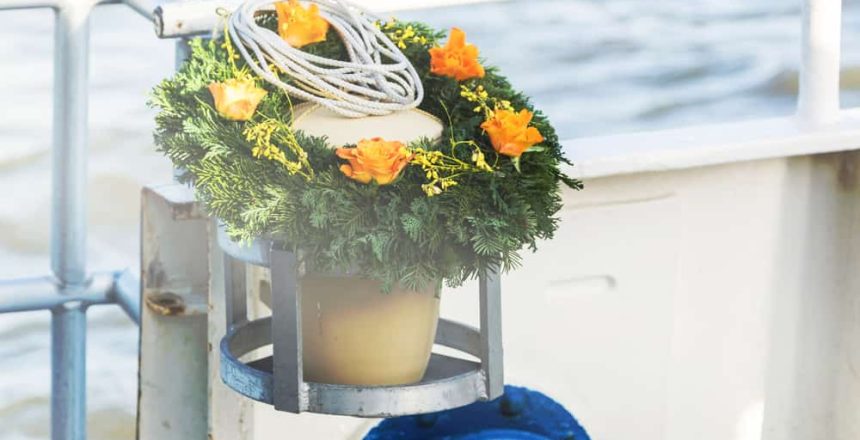
The ceremony itself typically has a natural flow: a welcome and opening remarks, personal eulogies or shared memories, music (live or recorded), a moment of quiet reflection, and a committal — the formal act of saying goodbye. For a sea burial, that committal is the release of the ashes into the water, which tends to carry a weight and finality that nothing else quite replicates.
What’s worth knowing is that “non-religious” doesn’t have to mean “no spiritual elements at all.” Some families want the ceremony to feel secular overall but still want a moment of prayer for family members who need it. That’s a completely reasonable ask, and it’s something we can accommodate — we can arrange for a priest to be present for those who want religious rites, while keeping the broader ceremony open and personal. The goal is always to serve the people in the room, not to enforce a particular philosophy.
When you’re not anchored to a church, the setting becomes a genuine choice. And for families on Nassau County’s south shore — people who grew up on the water, who spent summers at Jones Beach, who associate the Atlantic with freedom and peace — the ocean isn’t just a backdrop. It’s a place that already means something.
Why Families Delay a Memorial Ceremony — and What That Delay Actually Costs
Here’s something that doesn’t get talked about enough: a significant number of families receive their loved one’s cremated remains in the fall or early winter and then hold onto them for months, waiting for the “right time.” Sometimes that means waiting for spring. Sometimes it means waiting until the grief feels more manageable. Sometimes it means waiting because no one in the family knows what the next step actually is.
This is more common than you might think. More deaths occur between late November and early January than at any other time of year. That means more families are navigating the first Thanksgiving, the first Christmas, the first New Year’s — all while the ashes sit in a corner of the bedroom or on a shelf in the living room, a quiet presence that makes every holiday harder.
The delay is understandable. Grief is exhausting. Planning anything while you’re in the middle of it takes energy you don’t have. And if you assumed that a water-based ceremony wasn’t possible in December or January, it’s easy to tell yourself you’ll figure it out in the spring.
But the waiting has its own cost. The ceremony isn’t just for your loved one — it’s for you. It’s the moment that allows grief to shift from open-ended to something you can carry forward. Families who hold that ceremony often describe it as the first time they felt like they could breathe again. Families who keep waiting describe the delay as its own kind of weight.
The good news is that waiting for warmer weather isn’t actually necessary. The Seaspray — our Coast Guard-inspected vessel — has a heated cabin, which means we operate year-round. A January ceremony off the coast of Point Lookout is not only possible, it can be exactly the kind of quiet, intimate farewell that a cold, clear winter morning on the Atlantic makes possible in a way that a crowded summer day simply doesn’t.
Personalized Memorial Service: What a Sea Burial Actually Looks Like
A sea burial isn’t a military tradition reserved for Navy veterans. It’s a civilian option, available to any family, governed by federal EPA guidelines that we handle on your behalf. The ceremony takes place aboard the Seaspray, departing from our marina at 1 Anchorage Way, Slip A23 in Freeport, NY — right on Nassau County’s south shore, with direct access to the Atlantic via the Great South Bay.
What makes it a genuinely personalized memorial service is the degree of control your family has over every element. The music, the decorations aboard the vessel, the structure of the ceremony, who speaks and when — all of it is yours to shape. We’re there to guide the process and make sure the day runs smoothly. The vision is yours.

How the Ash Scattering Process Works — and What Happens After
Federal law under the Marine Protection, Research, and Sanctuaries Act requires that ash scattering at sea take place at least three nautical miles from shore. It also requires that only biodegradable materials be used — no plastic containers — and that EPA Region 2 be notified within 30 days of the scattering. We manage all of that for you. You don’t need to become an expert in maritime regulations to give your loved one a legal, dignified farewell.
The Seaspray sits low in the water, which matters more than it might sound. The ash release happens close to the surface, which makes the moment feel immediate and real rather than distant. For families who’ve attended other types of memorial services, this tends to be the detail they remember most.
After the ceremony, every family receives a certificate with the exact GPS coordinates of the scattering location. This is something people often underestimate until they have it in their hands. The ocean is vast — but this gives you a specific place. A location you can return to on the water, or simply carry with you as a fixed point on a map that means something only to your family.
For families who aren’t ready to be present for the scattering itself, we also offer unattended sea burials. We conduct the ceremony on your behalf, and you receive the same GPS coordinate certificate along with documentation of the service. Some families find this option easier emotionally; others prefer it for logistical reasons. Both are equally honored.
Non-Traditional Funeral Options in Nassau County: What Families Are Actually Asking
When Nassau County families start researching non-traditional funeral options, a few questions come up consistently. We’ll answer the ones we hear most often.
Can we bring our pet? Yes. Pets are welcome aboard the Seaspray. For many families, this matters more than they initially expect — being able to have a beloved animal present at a ceremony is a rare option, and it changes the feeling of the day in ways that are hard to articulate until you’ve experienced it.
What if some family members are religious and others aren’t? This is one of the most common dynamics we see, and it’s entirely workable. We can arrange for a priest to be present for those who want prayers and religious rites, while keeping the broader structure of the ceremony flexible and open. No one has to feel like they’re at the wrong service.
Is a sea burial really more affordable than a traditional burial? Traditional land burial in New York involves cemetery plots, burial vaults, and a long list of associated costs that add up quickly. A sea burial eliminates most of those expenses. We don’t publish pricing on our website — costs vary based on the type of service, the size of the group, and what the family wants — but we’re happy to walk you through everything. Burial Coordinator Maria Brusalis handles all pricing inquiries directly and can give you a clear picture of what to expect.
Is this really possible in winter? We get this question a lot, and the answer is yes. The Seaspray’s heated cabin means we operate in every season. Nassau County winters can be cold and gray, but a ceremony in January or February off Point Lookout has a stillness to it that summer simply doesn’t offer. If the holidays are bearing down and you’re ready to give your loved one a proper goodbye, you don’t have to wait.
Finding Closure After Loss: What Comes Next
A non-religious funeral service isn’t a lesser version of a real goodbye. For many families, it’s the first time a ceremony has actually felt like it fit — like it was built for the person being remembered rather than for the occasion itself.
If you’re somewhere in that in-between space right now — ashes at home, holidays approaching, not sure what the next step looks like — the most important thing to know is that you have options, and none of them require waiting until spring.
Eternal Peace Sea Burials is based in Freeport, right on Nassau County’s south shore, and we’re here year-round. If you want to talk through what a ceremony could look like for your family, reach out to us at 631-668-5800. There’s no script, no pressure — just a conversation about what would feel right.