Summary:
If you’ve been sitting with a loved one’s ashes and wondering what comes next, you’re not alone. Many families in Nassau County are in exactly that spot — cremation handled, ashes home, and no clear sense of what to do or how to do it. Scattering ashes at sea is something many people have heard of, but very few have actually seen. What does the moment look like? Is it peaceful, or is it awkward? Is it even legal? We answer those questions plainly, so you can make a decision with a clear head.
What Can Be Done With Cremation Ashes
Before getting into the sea specifically, it helps to know the full picture. Families have more options than they often realize. Some keep ashes at home in an urn. Some divide them among family members, sometimes placing a portion in cremation jewelry or a small keepsake. Others choose a land scattering — in a garden, a park, or somewhere personally significant.
There are also memorial reef burials, where ashes are incorporated into a concrete reef structure placed on the ocean floor, and tree burial services that use cremated remains to help grow a living memorial. Sea scattering is one of the most chosen options for families who want a ceremony that feels open, final, and genuinely beautiful — without the overhead of a traditional funeral. It’s not the right fit for everyone, but for many families, it turns out to be the one that finally feels right.
Can You Scatter Ashes at a Beach in Nassau County?
This is one of the most common questions we hear, and the answer matters: no, you cannot legally scatter ashes from a beach, pier, or dock. That includes the South Shore beaches most Nassau County families know well — Long Beach, Atlantic Beach, the barrier islands along Jones Beach Island. Standing at the shoreline and releasing ashes into the surf is a violation of federal law under the Marine Protection, Research, and Sanctuaries Act, commonly called the MPRSA.
The rule exists for environmental and public health reasons, and it applies nationwide. Cremated remains must be scattered at least three nautical miles from the nearest shoreline — that’s roughly three and a half miles out into open water. You can’t get there from the beach. You need a vessel.
This is the part that catches most families off guard. They picture a quiet moment at the water’s edge, and then they find out that’s not how it works. The good news is that the actual process — going out on a boat to the right distance — is far more meaningful than standing on a crowded beach would have been anyway. Out past Point Lookout, where the South Shore barrier islands give way to the open Atlantic, there’s a stillness and a sense of space that you simply can’t find on shore.
After a sea scattering, the EPA requires that the event be reported within 30 days. It’s not complicated, but it is required. When you work with us, that filing is handled for you — you don’t have to navigate any government portals on one of the hardest days of your year.
One more thing families sometimes ask: can you scatter ashes from a private boat? Technically yes, if you follow all the federal rules — three miles out, biodegradable materials only, EPA notification within 30 days. But most families who try to coordinate this on their own quickly realize they’re managing logistics at a moment when they’d rather be present. Having a captain and a dedicated burial coordinator on board means someone else is watching the wind direction, monitoring the distance, and making sure the moment unfolds the way it should.
Non-Traditional Funeral Options: Where Sea Scattering Fits
Sea scattering gets lumped into the “non-traditional funeral” category, but that framing can be a little misleading. Burial at sea is one of the oldest funeral traditions in human history. What’s non-traditional about it, in the modern sense, is that it doesn’t require a cemetery plot, a headstone, a funeral home, or a viewing. It’s a ceremony that happens on the water, in the open air, with the people who mattered most to the person who died.
For families who felt that a conventional funeral didn’t quite fit their loved one’s personality — or who are looking for something that honors the person without the formality and expense of a traditional service — sea scattering often fills that gap in a way nothing else does. It’s structured enough to feel like a real goodbye, and open enough to be shaped around who that person actually was.
This is especially true in Nassau County, where families come from a wide range of backgrounds, faiths, and traditions. Some families want a religious ceremony — and we can arrange for a priest to be present aboard for prayers and rites. Others want something more personal and informal, with music the deceased loved, flowers, and time to just be together on the water. Some want both. The ceremony can hold all of that.
What surprises most families is how much the setting does on its own. Once you’re out past the Freeport marina, moving through Reynolds Channel toward the open Atlantic, the ordinary world starts to fall away. By the time you reach the waters off Point Lookout, there’s a quality to the light and the quiet that makes the moment feel genuinely significant — not performed, not staged. Just real. Families who’ve been through it often say it was the most meaningful thing they did in the entire process of saying goodbye.
Sea scattering is also one of the most environmentally responsible options available. Cremated remains are calcium phosphate — they don’t harm marine ecosystems. The biodegradable urns and flowers used in the ceremony break down naturally. Nothing synthetic goes into the water. For families who cared about the environment, or who simply want a farewell that doesn’t leave a permanent mark on the land, that matters.
What an Ashes at Sea Ceremony Actually Looks Like
Most people have never attended a sea scattering ceremony. They’ve maybe seen something in a movie — ashes tossed dramatically from the bow of a boat — and they’re not sure if the real thing looks anything like that. It doesn’t, and it’s better.
Here’s what the experience actually looks like when you go out with us from Freeport. You arrive at 1 Anchorage Way, Slip A23, at the marina. You board the Seaspray, which sits low in the water — close enough to the surface that releasing ashes feels natural, not like leaning over a railing from a height. You head out through the channel, past the familiar landmarks of the South Shore, and into open water.

What Happens During the Ceremony Itself
Once you’re at the right distance from shore — well past the three-nautical-mile threshold — the captain positions the vessel upwind. This is one of those practical details that makes a real difference: when the boat is positioned correctly relative to the wind, the ashes release cleanly outward over the water rather than back toward the people on deck. It’s something an experienced captain handles automatically, but it’s worth understanding because it’s the thing families worry about most.
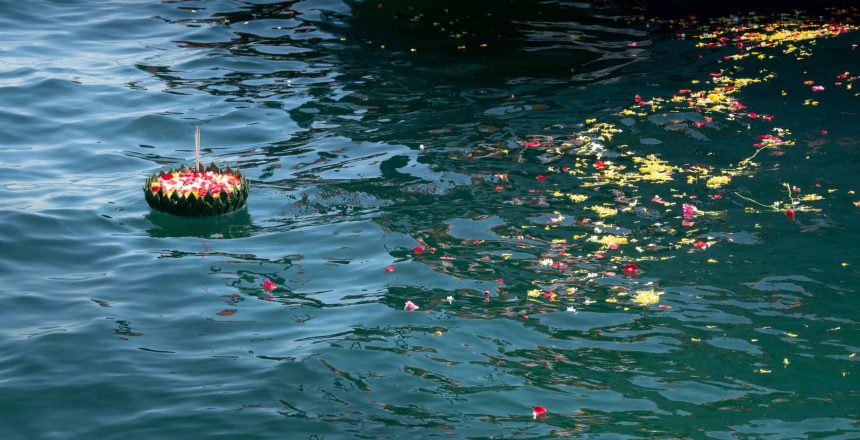
The ceremony itself is shaped around what your family brings to it. If you’ve arranged for a priest, the religious rites happen here, on the water, with the Atlantic around you. If you’ve chosen music, it plays. If you’ve brought flowers or a biodegradable wreath, those go into the water alongside the ashes. Some families read something. Some are quiet. There’s no script you have to follow.
The ashes themselves look different from what many people expect. Cremated remains are not fine ash like you’d find in a fireplace. They’re calcium phosphate — white to gray, slightly granular — and when released over moving water, they disperse and settle beneath the surface. The visual is gentle and calm. Most families find the moment more peaceful than they anticipated.
Maria Brusalis, our burial coordinator, is present throughout. Her role is entirely focused on the family — not on navigation, not on the vessel. She guides the ceremony, holds space for whatever the family needs, and makes sure the practical elements happen smoothly so that the people on board can simply be present. Having that dedicated person there, separate from the captain, changes the experience in ways that are hard to describe until you’ve been through it.
After the ceremony, we provide GPS coordinates of the scattering location. Families can keep those, return to the area on future anniversaries, or simply know that there’s a specific place in the Atlantic that holds that memory. It’s a small thing, but it matters to a lot of people.
Practical Questions Nassau County Families Ask Before Booking
Can we bring the whole family, including kids? Yes. The Seaspray is a Coast Guard-inspected vessel, and families of all ages come aboard. The low deck makes it accessible for older family members who might be nervous about being on a boat. Children are welcome, and the ceremony can be paced in a way that works for everyone present.
Can we bring our dog? We’re one of the very few services that says yes to this. If your loved one had a pet that was close to them, or if having the family dog present would mean something to your family, we welcome that. It’s a rare accommodation, and we offer it because we know how much it can matter.
What if the weather is bad? We operate year-round. The Seaspray has a heated cabin, which means a November or February ceremony is entirely possible and genuinely comfortable — you’re not standing on an exposed deck in the cold. If conditions are unsafe, we’ll reschedule. Safety is never negotiable, and we’d rather delay than rush a ceremony in rough water.
Do we have to decide everything in advance? No. Our burial coordinator works with families to understand what they want, and a lot of that conversation happens naturally in the planning process. If you want a simple, quiet ceremony with no formal elements, that’s fine. If you want music, a priest, flowers, and a specific playlist, we can build that. The ceremony is yours to shape.
What if we’ve had the ashes for a long time? This comes up more than people realize. Many Nassau County families have been holding onto a loved one’s ashes for months — sometimes longer — and feel a quiet guilt about it, or simply don’t know how to take the next step. There’s no wrong timeline. Whenever you’re ready, the process is the same, and we’ll walk you through it from the beginning.
Planning a Sea Scattering in Nassau County, NY
Throwing ashes into the sea is legal, meaningful, and far more accessible than most families expect. The federal rules are clear — three miles offshore, biodegradable materials, EPA notification within 30 days — and when you work with us, all of that is handled. What you’re left with is the ceremony itself: the water, the people you love, and a moment that most families describe as the most genuinely moving goodbye they could have given.
The waters off Point Lookout, accessible from Freeport’s marina, are some of the most beautiful along the entire South Shore. There’s a reason families from across Nassau County and Queens make the trip to that specific stretch of the Atlantic. It’s not just a location. It’s the right place.
If you’re ready to start planning, or if you just have questions and want to talk through what the process looks like, Eternal Peace Sea Burials is here. You can reach us at 631-668-5800.