
Summary:
If you’ve started looking into green burial, you’ve probably already noticed that the term gets used to describe a lot of different things. Natural cemeteries, biodegradable urns, human composting, scattering ashes at sea — they all fall under the same general umbrella, but they’re not the same experience, and they don’t all make sense for every family.
What most people really want is straightforward: a farewell that feels meaningful, doesn’t cause unnecessary harm, and doesn’t cost a fortune. We’ve put together this guide to cover the full range of eco-friendly burial options available today, with a focus on what actually matters to Nassau County families making this decision.
What Is Green Burial, and How Does It Differ from Traditional Burial?
Green burial, at its core, means returning the body to the earth — or the ocean — without the chemicals, concrete, and non-biodegradable materials that define conventional funerals. A traditional burial typically involves embalming fluid that contains formaldehyde (a known carcinogen), a metal or hardwood casket, a concrete vault, and ongoing chemical lawn maintenance at the cemetery. A green burial avoids all of that.
The environmental difference is significant. Vault burial emits approximately 250 pounds of carbon over its lifecycle. Green burial, by contrast, sequesters roughly 25 pounds of carbon. That’s a swing of about 275 pounds per burial — and it’s one reason more families are actively looking for alternatives.
Approximately 60% of New Yorkers now choose cremation over traditional burial, and that number continues to climb. But cremation alone doesn’t make a burial “green” — it depends on what happens with the ashes afterward, and whether the choices made along the way reflect the family’s values.
Environmentally Friendly Burial Options: The Full Spectrum
Natural land burial is probably what most people picture when they hear “green burial.” The body is buried without embalming, in a biodegradable shroud or simple wooden casket, in a natural cemetery that allows the land to remain as close to its native state as possible. There are approximately 470 certified green burial cemeteries across the United States and Canada as of late 2024, according to the Green Burial Council — a growing number, though still limited in many regions, including densely developed areas like Nassau County where land is at a premium.
Biodegradable urns are another option for families who have chosen cremation. These urns are designed to break down naturally over time — some in water, some in soil — and a few are even embedded with seeds so something living grows in place of the remains. They’re a meaningful way to handle cremated ashes while staying true to eco-friendly values.
Human composting, also called Natural Organic Reduction, is a newer option that New York State legalized in 2022. The process uses a controlled environment to transform the body into nutrient-rich soil over a matter of weeks. It’s a genuinely innovative alternative, though the infrastructure is still developing and availability in the New York metro area remains limited.
Aquamation — sometimes called water cremation or alkaline hydrolysis — uses water and an alkali solution to dissolve the body, leaving behind bone fragments similar to traditional cremation. It uses significantly less energy than flame cremation and produces no direct emissions. It’s worth knowing about, but it’s important not to confuse it with scattering ashes at sea. They’re entirely different processes.
And then there’s burial at sea — which is, for many Long Island families, the option that fits most naturally with the life they’ve actually lived.
Natural Burial Options and What They Actually Involve
Each of these options involves a different level of planning, cost, and emotional experience — and that’s worth thinking through honestly. A natural land burial requires finding a certified cemetery that accepts green burials (not all do), coordinating transportation of the body, and navigating the paperwork involved in any interment. In Nassau County, where cemetery space is limited and traditional funeral costs regularly run between $8,000 and $13,000, the logistics alone can be a barrier.
Biodegradable urns and memorial reef balls — where cremated remains are incorporated into an artificial reef structure — are more accessible but involve a different kind of ceremony. They’re quiet, private, and often handled without a formal gathering. That works for some families and not at all for others.
What distinguishes sea burial from most other green burial options is that it can be both eco-friendly and ceremonial at the same time. Families don’t have to choose between honoring the environment and having a real, meaningful goodbye. A ceremony on the water — with music, flowers, prayers, and the people who mattered most — is its own kind of sacred, regardless of religious background.
For Nassau County families, that combination is particularly resonant. The South Shore isn’t just a geographic backdrop — it’s the Great South Bay, Point Lookout, Jones Beach, the Freeport Nautical Mile. For a lot of people who grew up here, the water is already woven into the story of their family’s life. Sea burial doesn’t impose meaning. It draws on meaning that’s already there.
Spreading Ashes in the Ocean: What You Need to Know Before You Go
Scattering cremated remains at sea is legal in the United States, but it’s governed by specific federal regulations under the Marine Protection, Research and Sanctuaries Act. The rules exist for good reason, and they’re not complicated — but they do matter.
Ashes must be scattered at least three nautical miles from shore. Non-biodegradable containers cannot be released into the water — ashes must either be dispersed directly or placed in a biodegradable urn designed to dissolve. After the ceremony, the service provider is required to report the burial to the EPA within 30 days. We handle all of this on your behalf, so you’re not navigating federal permit systems while grieving.
What to Do with Cremation Ashes: More Options Than Most Families Realize
One of the most common questions we hear isn’t about burial at all — it’s from families who already have the ashes and don’t know what to do next. Maybe the cremation happened months ago. Maybe the urn has been sitting on a shelf, and no one has been able to agree on what comes next. That’s more common than most people admit, and there’s no shame in it.
The options for cremated remains are broader than most families realize. Ashes can be scattered at sea in a formal ceremony with family and friends aboard. They can be placed in a biodegradable urn and released into the ocean. A portion can be kept in a memorial keepsake while the rest is scattered. Some families choose to have ashes incorporated into memorial jewelry or artwork — small, wearable pieces that keep a physical connection close.
What matters is finding something that actually fits — the person who passed, the family’s values, and the kind of goodbye that will feel right years from now. There’s no universal answer, and there’s no deadline. But for families in Nassau County who feel drawn to the water, a sea burial ceremony off the coast of Point Lookout is one of the most genuinely meaningful options available.
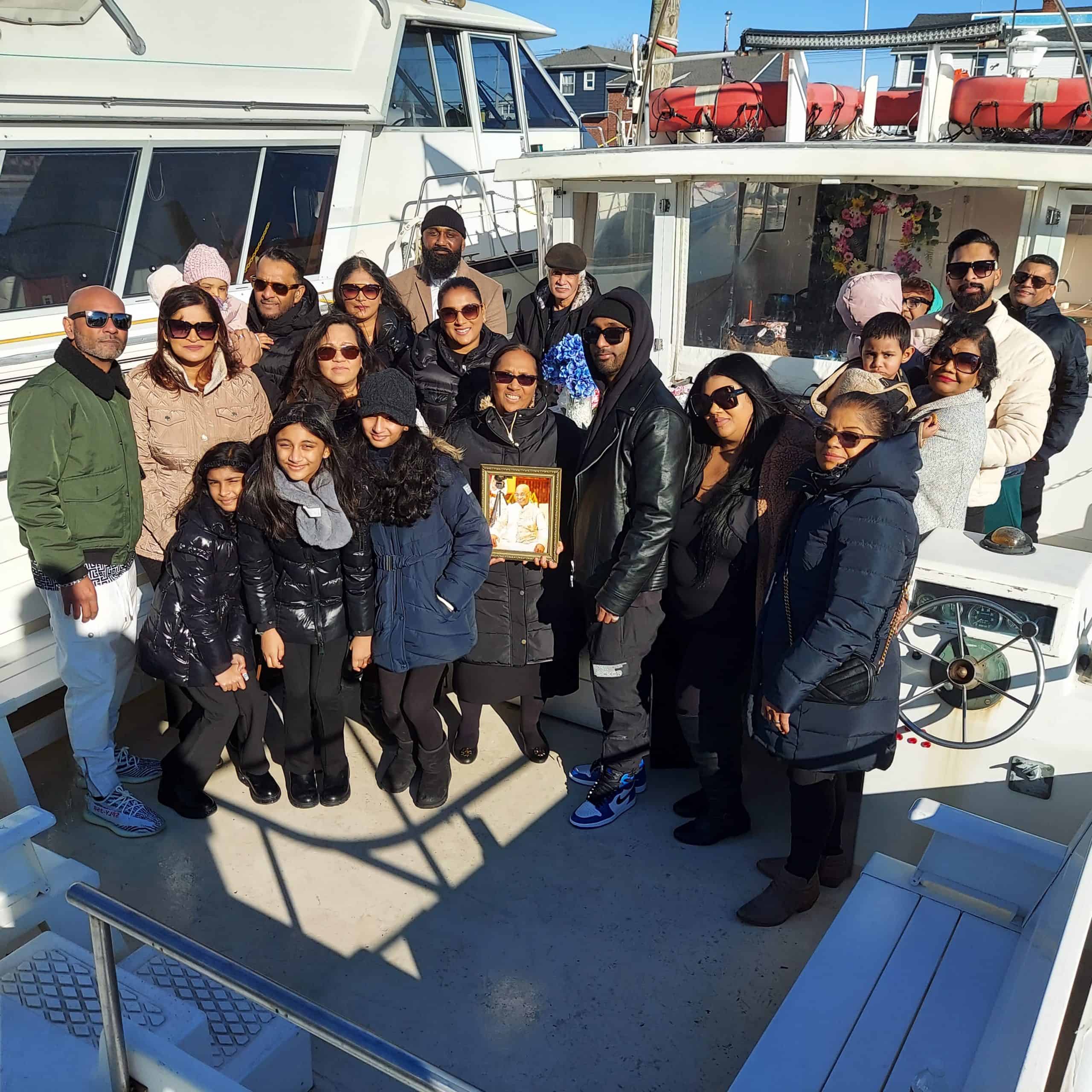
We depart from 1 Anchorage Way, Slip A23 on the Freeport Nautical Mile — a waterfront that most South Shore families already know. The ceremony takes place on the Seaspray, a Coast Guard-inspected vessel that sits low in the water for easy ash release, with a heated cabin that makes year-round services comfortable regardless of the season. Master Captain Scott Schafer leads every voyage, and Burial Coordinator Maria Brusalis is available to walk your family through every step of the planning process.
Attended services allow family and friends to be present on the water. Unattended services are available for families who prefer a private ceremony conducted on our behalf, with documentation provided afterward. Pets are welcome aboard. Catering is available. A priest can be present for religious rites and prayers if that matters to your family. These aren’t afterthoughts — they’re the details that make the difference between a task and a ceremony.
Disposal of Cremated Remains: What's Legal, What's Not, and What Most People Get Wrong
There’s a lot of confusion about what’s actually permitted when it comes to scattering ashes — and some of it leads families to do things that are technically illegal or that they later regret.
Spreading ashes on the beach is not the same as scattering ashes at sea. Public beaches are governed by local and state authorities, and scattering ashes on a beach generally requires explicit permission from the governing body — it is not covered by the same federal framework that applies to ocean scattering. Families who scatter ashes on a public beach without permission may be doing so illegally, even if it feels like a natural thing to do.
Scattering ashes in bays, harbors, or close to shore also doesn’t meet the federal three-nautical-mile requirement. The EPA standard exists specifically to ensure that remains are dispersed in open ocean water, not in the shallow coastal areas where people swim and fish. We ensure you’re in compliance — and that the ceremony takes place in the right location for the right reasons.
Full-body burial at sea involves additional requirements: a minimum water depth of 600 feet, proper weighting of the remains, and documentation from a physician confirming the absence of infection. It’s a more involved process, but it’s one we’re experienced in handling. All permits, death certificates, and post-ceremony EPA reporting are managed on your behalf, so the only thing your family needs to focus on is being present.
For Nassau County families specifically, it’s worth knowing that the waters off Point Lookout — where our ceremonies take place — meet all federal requirements. You’re not navigating this alone, and you’re not guessing.
Finding the Right Eco-Friendly Burial Option for Your Family on Long Island
Green burial isn’t one thing. It’s a range of choices, each with its own meaning, its own logistics, and its own emotional weight. What they share is a commitment to something more intentional than the default — a farewell that leaves less of a mark on the environment and more of one on the people who were there.
For Nassau County families, the ocean is already part of the picture. The South Shore, the bay, the Atlantic — these aren’t abstract concepts. They’re places you’ve been, places your family has gathered, places that carry real history. A sea burial ceremony draws on that connection in a way that no other green burial option can.
If you’re trying to figure out what comes next — whether you’re planning ahead or already holding an urn — we’re here to help you think it through. Reach out to us directly at 631-668-5800 and ask for Maria Brusalis. There’s no pressure, no script. Just a conversation about what would feel right for your family.
—
**Is burial at sea legal in New York?** Yes. Scattering cremated remains at sea is legal under federal EPA regulations, provided the ceremony takes place at least three nautical miles from shore and we file the required post-ceremony report with the EPA. For Nassau County families, our ceremonies take place off the coast of Point Lookout, well within federal compliance. We handle all documentation and reporting — your family doesn’t need to manage any of that.
**What are alternative burial options besides traditional burial?** The main eco-friendly alternatives include natural land burial in a green cemetery, biodegradable urns, human composting (Natural Organic Reduction), aquamation (water cremation), memorial reef balls, and burial at sea. Each option varies in cost, availability, and the kind of ceremony it allows. For families on Long Island, burial at sea is one of the most accessible and meaningful alternatives — and it’s the only one that lets you gather your family on the water for a real ceremony.
**What can I do with cremated remains besides keep them at home?** Quite a bit. Ashes can be scattered at sea, placed in a biodegradable urn for ocean release, incorporated into memorial jewelry or keepsakes, used to plant a tree, or interred in a green burial cemetery. Some families split the ashes so different family members can honor their loved one in different ways. If you’re not sure what feels right, that’s a completely normal place to be — and it’s worth talking through your options before making a final decision.
**Can Catholics scatter ashes at sea?** The Catholic Church permits cremation but generally encourages that cremated remains be kept together and interred in a sacred place rather than scattered. That said, many Catholic families choose sea burial and find it deeply meaningful. We’re able to have a priest present during the ceremony for religious rites and prayers, which addresses much of the concern around the spiritual dimension of the service. We’d always encourage families to speak with their own priest or spiritual advisor to find the approach that feels right for their faith.
**What can I do with my mom’s or dad’s ashes?** This is one of the most common questions we hear, and there’s no single right answer. What matters most is finding something that reflects who they were and what your family needs. For Nassau County families who had a parent with a connection to the water — or simply want a ceremony that feels open, natural, and genuinely beautiful — a sea burial off the South Shore is worth considering. We offer both attended services (where family comes aboard) and unattended services for families who prefer a private ceremony on our behalf.
**Can you scatter ashes on the beach in New York?** Scattering ashes on a public beach in New York requires permission from the governing authority and is not covered by the same federal EPA framework that applies to ocean scattering. It’s a different process with different rules, and doing it without permission can create legal complications. Scattering at sea — at least three nautical miles offshore — is the legally clear path, and it’s what we do. If you’re unsure about the distinction, we’re happy to walk you through it.
**What is a sea burial service?** A sea burial service is a ceremony — attended or unattended — in which cremated remains (or, in some cases, a full body) are committed to the ocean. For attended services, family and friends board the vessel and participate directly: sharing memories, releasing flowers, offering prayers, or simply being present on the water together. For unattended services, we perform the ceremony on the family’s behalf, and documentation is provided afterward. We serve Nassau County and Queens from our departure point on the Freeport Nautical Mile.
**Are there burial at sea companies near Nassau County?** Yes. Eternal Peace Sea Burials operates directly from the Freeport Nautical Mile — 1 Anchorage Way, Slip A23, Freeport, NY 11520 — which is on Nassau County’s South Shore. Freeport is roughly 45 minutes from Manhattan and is served by the Long Island Rail Road, making it accessible for family members coming from the city as well as from across Nassau County. You can reach us at 631-668-5800.
**What can I put ashes in for a sea burial?** For ocean release, ashes must be placed in a biodegradable urn designed to dissolve in water, or dispersed directly into the sea. Non-biodegradable containers cannot be released into the ocean under EPA regulations — they must be brought back to shore. We offer biodegradable urn options as part of our services, and we can walk you through what works best for the kind of ceremony you have in mind.
**Is there a non-religious sea burial option?** Absolutely. Many families who choose sea burial have no religious affiliation at all — and the ocean setting carries its own natural solemnity that doesn’t require a religious framework to feel meaningful. We can accommodate fully secular ceremonies with music, personal tributes, flower petals, and whatever else reflects the person you’re honoring. For families who do want religious rites, we’re also able to have a priest present. The service is yours to shape.