
Summary:
For most families in Queens County, planning a funeral means navigating a process that’s expensive, unfamiliar, and emotionally exhausting — all at once. Traditional burial has long been the default, but more families are asking whether it’s still the right fit. Cremation rates in the U.S. have crossed 62%, and with that shift comes a real question: what do you do next? Burial at sea is one answer — and it’s more accessible, more meaningful, and more regulated than most people realize. Here’s what you actually need to know before making a decision.
Burial at Sea vs Traditional Burial: What the Cost Difference Actually Looks Like
The national median cost of a traditional funeral with viewing and burial runs between $8,300 and $10,848, according to the National Funeral Directors Association. In Queens County and the broader New York City metro area, that number climbs higher once you factor in cemetery plots, headstones, burial vaults, and ongoing maintenance fees. All told, families here regularly spend $10,000 to $20,000 or more.
A burial at sea ceremony is a fraction of that. Our attended services, where your family joins us on the water for the scattering, typically range from $700 to $3,000 depending on group size and what you’d like included. That’s not a stripped-down experience — it’s a fully personalized ceremony on open water, handled by licensed professionals, with documentation of exactly where your loved one came to rest.
Why Queens County Families Are Rethinking the Traditional Cemetery Route
Queens County is home to some of the largest cemeteries in the United States — Calvary Cemetery alone holds millions of interments. But available plots are increasingly scarce, and the cost of securing one in this borough has risen steadily alongside everything else in New York City. For families already managing the financial weight of loss, a $5,000 to $15,000 cemetery plot — before any other expenses — is a significant burden.
There’s also a practical reality that doesn’t get talked about enough: cemeteries require ongoing maintenance fees, headstones deteriorate over decades, and some cemeteries have closed or relocated remains over the course of a century. The ocean doesn’t have those problems. The coordinates where your loved one’s ashes were scattered don’t change, don’t require upkeep, and don’t belong to anyone.
For Queens County families with roots in Hindu tradition — particularly in Jackson Heights, Richmond Hill, and Ozone Park — the ocean carries specific cultural and spiritual significance. Scattering ashes in sacred water is central to Hindu end-of-life practice, and for families who cannot travel to the Ganges, the open Atlantic off Long Island’s South Shore is a meaningful and accessible alternative. We’ve served many families from these communities, and we shape every ceremony to honor those traditions fully.
Beyond the financial and cultural dimensions, there’s something worth saying plainly: many families who choose sea burial report that it’s the most beautiful funeral they’ve ever attended. The open water, the horizon, the act of releasing someone you love into something vast and enduring — it doesn’t feel like a compromise. It feels like exactly the right goodbye.
Is Burial at Sea Legal in New York? What the Regulations Actually Require
This is one of the first questions families ask, and the answer is straightforward: yes, burial at sea is fully legal in New York, and the regulatory framework is clear.
Ocean burials in the United States are governed by the Marine Protection, Research and Sanctuaries Act (MPRSA), administered by the U.S. Environmental Protection Agency. Under the EPA’s general permit — specifically 40 CFR 229.1 — cremated remains can be scattered in ocean waters as long as the scattering takes place at least three nautical miles from shore. No advance permit application is required for cremated remains. The responsible party does need to notify the EPA within 30 days after the burial, but that’s administrative paperwork — not something families need to handle themselves.
One important distinction for New York families: this permit applies to ocean waters only. Scattering ashes in Jamaica Bay, the East River, or other inland or bay waters within Queens County is governed by a different set of rules under the Clean Water Act and potentially state and local regulations. When you depart from Freeport and travel offshore into the Atlantic, you’re operating in the right jurisdiction — and we handle all required documentation and EPA reporting on your behalf.
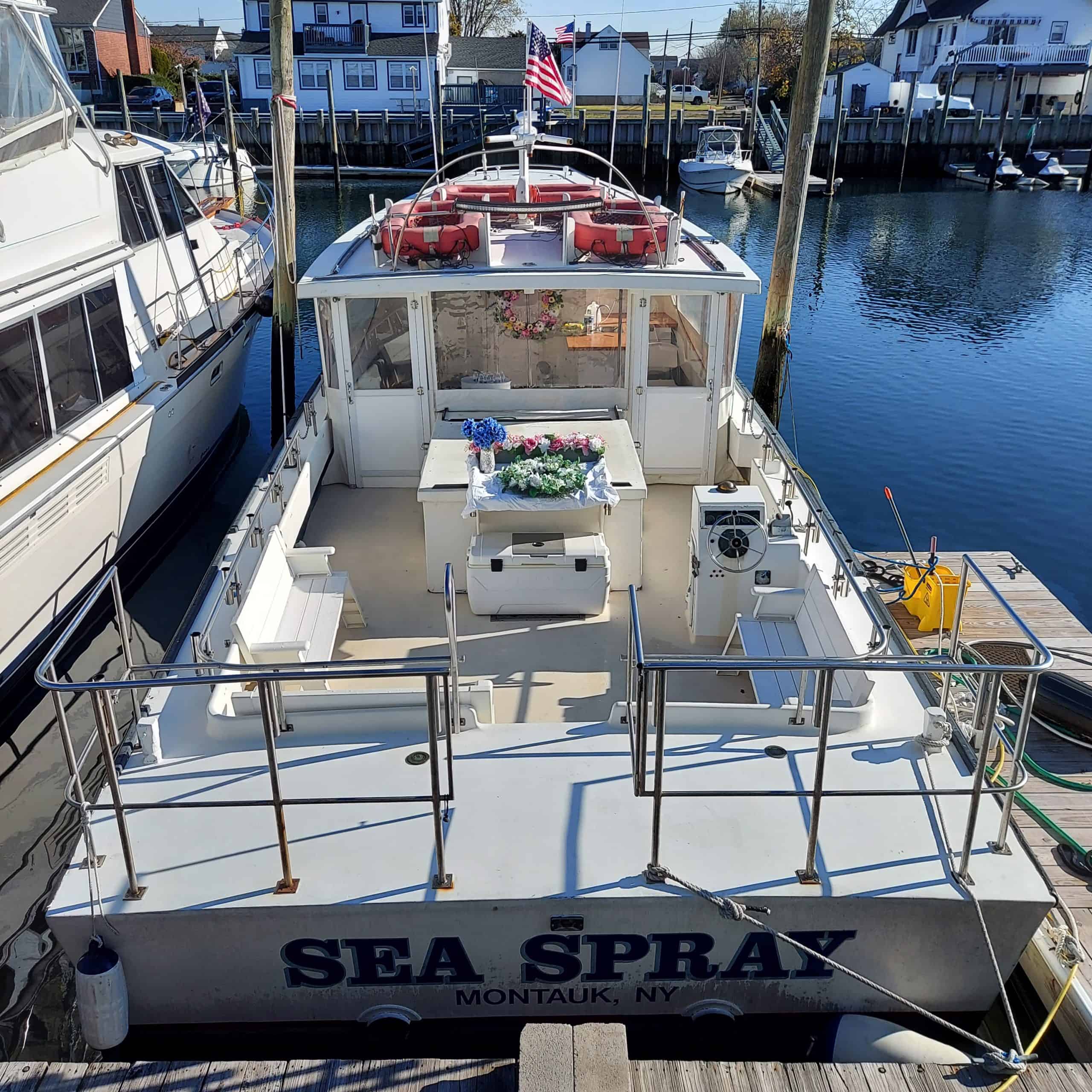
All of our captains hold U.S. Coast Guard Master Licenses, which is the highest civilian maritime credential available. Our vessel, the Seaspray, has been formally inspected and certified by the Coast Guard for passenger safety. We travel a minimum of three nautical miles offshore on every service — not because it’s convenient, but because it’s the legal and professional standard. Compliance isn’t a selling point; it’s the foundation of doing this right.
What a Burial at Sea Ceremony Actually Looks Like
A lot of families come to us with a vague picture of what a sea burial involves — and often, they’re surprised by how much it can be shaped around what matters to them. This isn’t a standardized process where everyone gets the same fifteen minutes on the water. Every ceremony we conduct is different, because every family is different.
You can bring a priest or officiant for religious rites. You can request a specific music playlist, arrange for flowers, or have catering on board for a larger gathering. Pets are welcome — because for many families, a beloved dog or cat was as much a part of the home as anyone, and leaving them behind for the ceremony doesn’t feel right. The Seaspray accommodates all of this.
What Happens If the Weather Doesn't Cooperate on the Day of the Ceremony?
Weather off the Atlantic coast is unpredictable, and families coordinating travel from different parts of Queens County — or flying in from out of state — reasonably worry about what happens if conditions are rough on the scheduled day. It’s one of the most common concerns we hear, and it deserves a direct answer.
If weather forces a change of plans, we work with you to reschedule. While payments are nonrefundable, flexible rescheduling is always on the table. That policy exists because we understand what’s at stake — you’re not rescheduling a dinner reservation. You’re coordinating something that matters deeply to your family, often with people who’ve taken time off work or traveled a distance to be there.
We also operate year-round, which matters more than it might seem at first. The Seaspray has a heated cabin, which means winter ceremonies are genuinely comfortable — not something to endure. For families who need to schedule a service in November, December, or February, whether because of a religious timeline, a death anniversary, or simply because that’s when everyone can gather, we’re not going to tell you to wait until spring. Most providers in this area can’t say the same.
The Seaspray also sits low in the water, which is a practical detail that makes a real difference for elderly guests or anyone with limited mobility. The act of releasing ashes directly into the ocean is often the most meaningful moment of the ceremony. A vessel designed to make that possible for everyone — not just the physically able — reflects the kind of thought that goes into how we run these services.
Attended vs Unattended Sea Burial: How Do You Know Which Is Right for Your Family?
There are two main ways families approach a sea burial, and both are valid depending on your circumstances.
An attended service means your family joins us on the Seaspray for the ceremony. You’re present for the scattering, you can participate in whatever rituals or readings feel right, and you experience the moment together. For many families, this is the most important part — being there, as a group, to say goodbye.
An unattended service means our captain and crew conduct the scattering on your behalf. This option works well for smaller families, for situations where travel is difficult, or when the deceased specifically requested a private, quiet farewell without a gathering. We perform the service with the same care and professionalism regardless of whether anyone is watching.
In both cases, you receive a formal certificate documenting the exact GPS coordinates of where the ashes were scattered. That certificate is more than a piece of paper — it’s a permanent record of a specific place in the ocean that belongs to your family. You can return to those coordinates by boat. You can frame the certificate. You have something tangible that marks where your loved one came to rest, which addresses one of the most common hesitations families express: the feeling that the ocean doesn’t offer the same permanence as a headstone. It does — just differently.
For Queens County families coordinating services across different neighborhoods, from Forest Hills to Queens Village to Queensboro Hill, the departure from Freeport is accessible via the Southern State or Meadowbrook Parkway — roughly 30 to 45 minutes from most parts of the borough. It’s close enough to be practical and far enough that, by the time you reach open water, the city feels far away.
Choosing Between Burial at Sea and a Traditional Funeral in Queens County
There’s no universal right answer here. Traditional burial makes sense for some families — for those with strong ties to a specific cemetery, a religious tradition that requires interment, or a community where visiting a grave site matters deeply. But for many Queens County families, the cost, the land scarcity, and the growing openness to cremation have made sea burial a genuinely compelling option — not a fallback, but a first choice.
What matters most is that the service is handled by people who take it seriously. Licensed captains, a certified vessel, full regulatory compliance, and a ceremony built around your family’s needs — those aren’t extras. They’re the baseline.
If you’re weighing your options and want to talk through what a sea burial would look like for your family, we’re here to help you figure out whether it’s the right fit — no pressure, just a real conversation.