Summary:
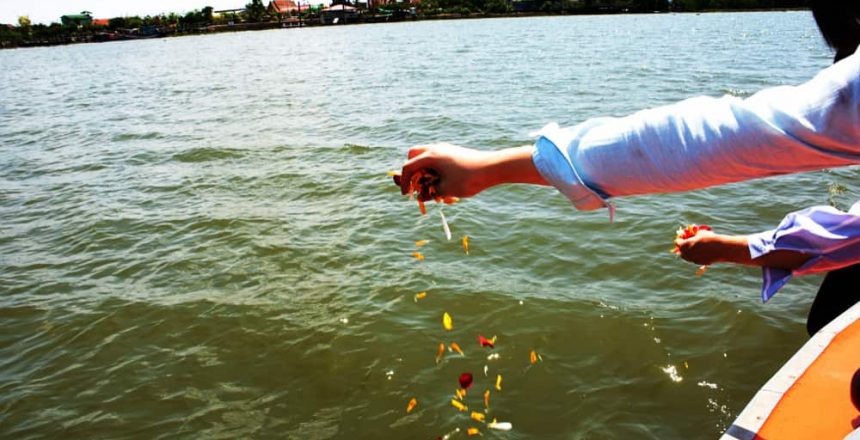
Most families who reach out to us have already been sitting with the ashes for a while. Weeks, sometimes months. They knew they wanted something meaningful — something that felt right — but weren’t sure where to start, what was legal, or who to trust with something this important. If that’s where you are right now, you’re not behind. You’re just trying to do this thoughtfully, which is exactly the right instinct. Queens County families have a natural connection to the Atlantic — the Rockaways, Jamaica Bay, the South Shore just over the bridge — and for many, returning a loved one to the ocean makes more sense than anything else. Here’s what you actually need to know before you plan a sea burial.
Scattering Ashes at Sea: What the Law Actually Requires
The single most common question we hear is some version of: “Is this even legal?” It is — but there are specific federal rules that govern how and where cremation ashes can be scattered at sea, and most families have never heard of them.
Under the Marine Protection, Research, and Sanctuaries Act, cremated remains must be scattered at least three nautical miles from shore. That’s roughly 3.45 statute miles. You cannot scatter ashes from Rockaway Beach, from a pier, or anywhere in the wading area near the coast — even though those spots may feel meaningful. The open Atlantic, at the required distance, is where a sea burial legally takes place.
After the scattering, the EPA requires notification within 30 days. No advance permit is needed — just the post-ceremony notification. We handle this as part of our service, so you don’t have to navigate government paperwork while you’re still grieving.
Biodegradable Urn for Burial at Sea: Why the Container Matters
Here’s something that catches a lot of families off guard: if you want to place an urn in the ocean rather than scatter loose ashes, that urn must be made entirely of biodegradable materials. No plastic. No metal. No ceramic. Nothing that floats or leaves a trace. The EPA is specific about this, and it’s not a technicality — it’s about protecting the coastal ecosystem that makes a sea burial meaningful in the first place.
Many families arrive with the urn from the funeral home, not realizing it doesn’t qualify. Standard funeral urns are almost always made of metal, wood, or ceramic — none of which can legally be placed in open water. Loose scattering is always permitted at the required distance, but if you want the urn to go into the ocean with the ashes inside, the container has to meet federal material standards.
We provide biodegradable urns as part of our service, so this is one less thing you have to research, source, or worry about getting wrong. These urns are made from natural materials — compressed salt, sand, or plant-based fibers — that dissolve cleanly in seawater without leaving any environmental impact. For families who want the visual of watching the urn enter the water, it’s a genuinely beautiful moment, and knowing it’s handled correctly makes it easier to be fully present for it.
One more thing worth knowing: you don’t have to scatter all of the ashes at sea. There’s no legal requirement that all cremated remains be disposed of in the same way. Some families scatter a portion at sea and keep the rest in a keepsake urn at home, or spread them in multiple places that mattered to your loved one. A sea burial can be part of a larger memorial — not necessarily the only one.
Environmental Regulations for Ash Scattering: What "EPA Compliant" Actually Means
When a sea burial service says they’re EPA compliant, it should mean more than just traveling the required distance. Full compliance covers the three-nautical-mile minimum, biodegradable materials only, no plastics or synthetic flowers in the water, and the post-ceremony EPA notification filed within 30 days of the scattering. All of that falls under 40 CFR §229, the specific federal regulation governing burial at sea.
Why do these rules exist? Primarily to protect swimming beaches and nearshore ecosystems. At three nautical miles, ocean currents carry remains offshore and disperse them naturally into deeper water. Closer to shore, that doesn’t happen the same way — which is why Jamaica Bay, as beautiful as it is, isn’t a legal scattering location. It’s a protected estuary within Gateway National Recreation Area, and families from Howard Beach or Broad Channel who are drawn to it for sentimental reasons should know that the open Atlantic, accessible from the South Shore, is the right place.
There’s also a practical reason to care about compliance beyond avoiding a fine: knowing you followed the law correctly matters when you’re already carrying a lot emotionally. The families we work with in Queens County — from Rockaway Park to Flushing to Queens Village — want to know they honored their loved one properly, not just in spirit but in fact. That peace of mind is part of what our licensed, experienced captain provides.
One distinction that rarely gets explained: not all charter captains hold the same credentials. A standard OUPV license — sometimes called a Six-Pack license — caps a vessel at six paying passengers on an uninspected boat. Our captain, Master Captain Scott Schafer, holds a US Coast Guard Master License, which is required to operate an inspected vessel carrying larger groups. The *Seaspray* is a Coast Guard-inspected vessel, which means it’s been built and maintained to commercial inspection standards — not just a recreational boat with a licensed driver. For families bringing elderly parents, grandchildren, or a larger group, that distinction is worth understanding before you book.
What Queens County Families Ask Before Booking a Sea Burial
Beyond the legal questions, there are practical ones — the kind that don’t show up on government websites but come up in almost every conversation we have with families before they book. Some are logistical. Some are emotional. A lot of them are about whether the experience will actually feel the way they’re hoping it will. These are the questions worth answering honestly, because a sea burial is a once-in-a-lifetime moment and you deserve to know exactly what you’re walking into.
Can the Whole Family Come — and What If Someone Can't Make It?
This comes up constantly, especially in Queens County, where families tend to be large and multi-generational. The short answer is yes — and the size of the group matters more than most people realize when they’re comparing services.
Because the *Seaspray* is a Coast Guard-inspected vessel operated by a captain with a Master License, we can legally accommodate groups larger than six passengers. That’s not true of every sea burial operator. A Six-Pack license caps a vessel at six paying passengers on an uninspected boat — which means some services are quietly turning away family members or splitting groups across multiple trips without ever explaining why. If you’re planning to bring a larger family, ask the operator directly what their passenger capacity is and what license the captain holds.
For families where someone genuinely can’t attend — a relative overseas, an elderly parent who can’t travel, someone who’s simply not ready — we also offer unattended sea burials. We perform the service on your behalf, and you receive a certificate marking the exact GPS coordinates of where the ashes were scattered. That certificate is more than a formality. It gives the people who couldn’t be there a permanent, specific place to hold onto — coordinates they can look up, share with others, or simply keep as a tangible piece of closure. Families tell us it matters more than they expected it to.
Pets are welcome aboard during the journey, too. For families who want to bring a dog or another companion animal, or for those arranging a pet burial, that’s something we explicitly accommodate — which is rarer than it should be.
Does a Sea Burial Work for Religious Families in Queens County?
This is a question that comes up often in Queens County specifically, and it’s worth addressing directly. Queens County is one of the most religiously diverse places in the country — large Catholic communities in Howard Beach, Woodhaven, and Maspeth; Greek Orthodox families in Astoria; faith communities of nearly every tradition spread across the borough. For many of these families, the concern isn’t whether they *want* a sea burial — it’s whether they can have one without setting aside their faith.
The answer is yes. We can arrange for a priest to be present for religious rites and prayers during the ceremony. A sea burial doesn’t have to be secular, and it doesn’t require you to choose between a meaningful setting and a meaningful tradition. The ceremony can include whatever prayers, readings, or rituals matter to your family — on the water, with the people who loved your loved one, in a setting that feels genuinely personal rather than institutional.
Beyond the religious question, families also ask about the physical experience of being on the boat. The *Seaspray* sits low in the water, which means the release of ashes is natural and close — not a matter of leaning over a high railing and hoping for the best. The vessel has a heated cabin, so even in November or February, when grief doesn’t pause for the season, the service runs comfortably. You don’t have to wait until spring. You don’t have to delay a memorial because of the weather. For families who’ve already been waiting — holding the ashes, putting off the decision — that matters.
We depart from Freeport, NY, on the South Shore of Long Island. For most Queens County families, that’s a 30 to 40-minute drive down the Southern State Parkway — a familiar trip, not a distant one. And once you’re out on the water, past the barrier islands and into the open Atlantic, you’ll understand why so many families from this part of New York choose this over anything else.
Planning a Sea Burial for Cremation Ashes: Where to Start
If you’ve made it this far, you’re probably not just casually curious. You have someone in mind. And you want to do this right.
The most important things to know: scattering cremation ashes at sea is legal, meaningful, and fully manageable when you work with a licensed captain who handles the compliance, the documentation, and the details you shouldn’t have to carry alone. The three-nautical-mile rule, the biodegradable urn requirement, the EPA notification — all of that is part of what our professional service takes off your plate.
When you’re ready to talk through the specifics — group size, timing, religious needs, or simply what the day actually looks and feels like — reach out to us at Eternal Peace Sea Burials. Our burial coordinator, Maria Brusalis, is the person you’ll speak with first, and she’s there to answer every question without pressure, at whatever pace makes sense for your family.