
Summary:
If your loved one served and wanted to be returned to the sea, you’re probably discovering that the path forward is more complicated than you expected. There’s the official Navy program, federal regulations you’ve never heard of, paperwork that nobody warned you about, and a quiet but persistent question underneath all of it: can we actually be there?
The answer depends on which route you take. This page breaks down how military burial at sea works, what the Navy ceremony involves, what the law requires, and what your options look like as a family in Queens County, NY who wants to do this right.
Navy Funeral at Sea: What the Official Ceremony Actually Involves
The US Navy has performed burial at sea ceremonies for centuries. The tradition is rooted in practical necessity — sailors who died far from shore needed to be committed to the water — but over time it became one of the most solemn and meaningful rituals in military culture.
Today, the Navy’s official burial at sea program handles an average of around 1,500 cremated remains burials per year. The ceremony follows a precise protocol: the flag flies at half-mast, Scripture is read, prayers are offered, a three-volley salute is fired, Taps is played, and the flag is folded thirteen times — once for each of the original colonies — before being presented to the next of kin. It is a dignified, carefully observed tradition.
What most families don’t know until they’re already in the middle of it is that the ceremony happens aboard a deployed naval vessel, and the family is not permitted to attend.
Who Is Eligible for Military Burial at Sea?
Eligibility is broader than most people assume. The official Navy program is open to active duty members of all US military branches — not just the Navy. Retired military personnel qualify, as do honorably discharged veterans of any branch. US civilian marine personnel serving with the Military Sealift Command are also eligible, and dependent family members of eligible veterans can be included as well.
One of the most common misconceptions is that burial at sea is reserved for sailors or Navy veterans specifically. That’s not the case. An Army veteran from Howard Beach or an Air Force retiree from Bayside has the same eligibility as a career Navy officer. Branch of service doesn’t determine eligibility — honorable service does.
To initiate the official Navy program, families contact Navy and Marine Corps Mortuary Affairs at 833-330-6622 and submit the veteran’s DD-214 discharge papers along with a certified death certificate. From there, the Navy coordinates the ceremony around an active deployment schedule — which is where the timeline gets complicated.
Wait times for the official program can stretch from several months to well over a year. The ceremony is performed when a qualified ship is available and deployed in the appropriate waters, not on a schedule that families can plan around. For families who have already been through the difficulty of loss, storing cremated remains at home for an indefinite period while waiting for a date is a real and painful reality. Many Queens County families who come to us have been waiting — and simply reached a point where they needed a different path.
The official program is free, and for some families it’s the right choice. But if being present matters to you, if gathering the family together for a real goodbye is part of what you need, the Navy program won’t give you that. That’s not a criticism — it’s just the honest reality of how the program works.
What Happens During a Military Burial at Sea Ceremony?
Whether the ceremony is performed by the Navy or by a civilian provider with military honors, the core elements remain consistent. The flag is displayed at half-mast as the vessel proceeds to the committal site. An officiant — a chaplain, clergy member, or designated leader — reads a committal prayer or Scripture passage. The three-volley salute is fired, a tradition with roots in ancient Roman military customs that was carried into American military practice through British tradition. Taps follows.
The flag folding is one of the most visually powerful moments of any military funeral. Each of the thirteen folds carries meaning — the first represents life, the fourth honors a veteran’s trust in God, the eleventh honors the God of Abraham, Isaac, and Jacob. The final triangular shape is said to represent the tri-cornered hat worn by soldiers of the American Revolution. The folded flag is then presented to the next of kin with the words, “On behalf of the President of the United States and a grateful nation.”
When the ceremony is attended — when the family is actually on the water — the moment of ash release carries a weight that’s difficult to describe in advance. Families who have been through it often say it’s the most meaningful farewell they’ve ever witnessed. The ocean does something that a cemetery simply can’t. There’s an openness to it, a sense of return, that brings a particular kind of peace.
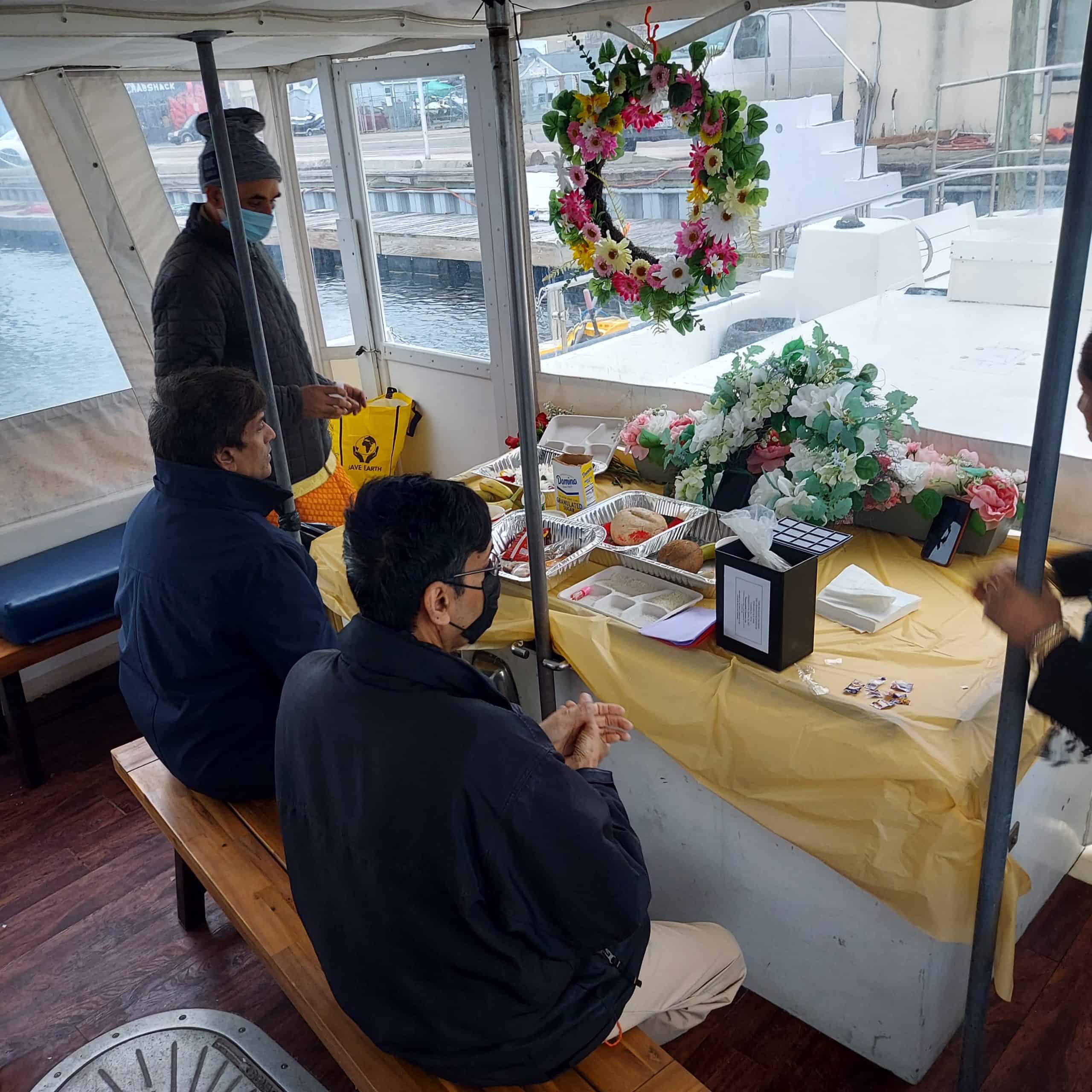
For a civilian attended ceremony, the vessel matters more than people realize. We specifically use the *Seaspray* because it sits low in the water, which makes the ash release natural and accessible — especially for elderly family members or anyone who isn’t comfortable leaning over a high railing at a moment like this. That’s not a minor detail. It’s something families notice and remember.
Sea Burial Laws: What Federal Regulations Require
Regardless of whether a burial at sea is conducted through the Navy or a civilian provider, federal law applies. The governing regulation is the Marine Protection, Research, and Sanctuaries Act, codified at 40 CFR §229.1, which sets the baseline requirements for all sea burials in US waters.
The rules are straightforward. Cremated remains must be scattered a minimum of three nautical miles from shore. Only biodegradable materials may be placed in the water — no plastic, no synthetic flowers, no non-biodegradable containers. And within 30 days of the burial, a notification must be filed with the EPA confirming the date, location, and nature of the committal.
Families who try to navigate this alone often don’t know the notification requirement exists until after the fact. We handle all EPA filings on behalf of the families we serve — it’s part of the process, not an add-on.
Full-Body Burial vs. Ash Scattering: How the Rules Differ
The legal requirements for full-body burial at sea are more specific than those for cremated remains. A full-body burial must take place in water at least 600 feet deep — approximately 100 fathoms — to ensure the remains are well below shipping lanes and recreational waters. This depth requirement doesn’t apply to ash scattering; the only federal standard for cremated remains is the three-nautical-mile distance from shore.
In practice, the vast majority of civilian sea burials today involve cremated remains rather than full-body committal. Full-body burial requires coordination with a licensed funeral director, a specially prepared casket, and access to deep-water sites — logistics that most families aren’t equipped to manage independently. Ash scattering is simpler, more accessible, and equally meaningful.
New York waters off the South Shore of Long Island — where we depart from Freeport — provide the right conditions for a fully compliant, EPA-approved ceremony. The Atlantic beyond the three-nautical-mile line is where the *Seaspray* takes families, and it’s where the ceremony takes place. We provide biodegradable urns so families don’t have to source compliant containers on their own, and we travel the required distance on every single departure. Compliance isn’t something families should have to think about — it should already be handled.
One thing worth knowing: New York State does not impose additional permitting requirements on top of the federal standard for ocean ash scattering. The EPA general permit covers it. Some families worry they’re missing a state-level filing; in most cases, the federal notification is all that’s required. If your situation involves any complexity — religious requirements, full-body committal, or military documentation — we walk through all of it with you before the day of the ceremony.
What Documentation Do Military Families Need for a Sea Burial?
For the official Navy program, the core documents are the DD-214 discharge papers and a certified death certificate. The DD-214 establishes the veteran’s service record and eligibility; without it, the Navy cannot process the request. If the family doesn’t have a copy, it can be requested through the National Archives’ eVetRecs system, though that process takes time — another reason families sometimes find themselves in a prolonged waiting period.
For a civilian attended ceremony with military honors, the documentation requirements are less bureaucratic but still important. We ask families to provide the DD-214 so we can confirm eligibility and incorporate the appropriate honors into the ceremony. A death certificate is also required. Beyond that, we coordinate the rest — the EPA filing, the ceremony documentation, and the Certificate of Final Resting Place that we provide after every service.
That certificate matters more than it might seem at first. It records the exact GPS coordinates — latitude and longitude — of where your loved one was committed to the sea. For military families who understand the importance of precision and record-keeping, having a formal document that marks the exact location is a meaningful piece of closure.
For Queens County families specifically, the process of gathering documents while also managing arrangements in a dense, busy borough can feel overwhelming. The St. Albans VA Medical Center is a resource many local veterans’ families are already familiar with, and their records staff can assist with DD-214 requests. If you’re not sure where to start, reaching out to the NYC Department of Veterans’ Services is also a reasonable first step — they have staff specifically trained to help families navigate exactly this kind of situation.
Planning a Military Sea Burial in Queens County, NY
Queens County is home to more veterans than any other borough in New York City — roughly 27.9% of the city’s entire veteran population lives here, with Vietnam-era veterans making up the largest single cohort. These are families who have been waiting, in some cases for years, to give their loved one a farewell that feels right.
The official Navy program is a meaningful option for some. But if you want to be there — if the family needs to gather, to participate, to actually witness the moment — a civilian attended ceremony is the only path that makes that possible. We operate the *Seaspray* year-round out of Freeport, about 35 minutes from most Queens neighborhoods, with a heated cabin for cold-weather ceremonies and a crew that understands what military families are carrying when they step aboard.
If you’re in the early stages of planning, or if you’ve been waiting on the Navy program and are starting to wonder whether there’s another way, we’re here to walk through it with you — no pressure, no paperwork left in your hands, just a straightforward conversation about what’s possible.