Summary:
You’ve probably already thought about flowers. Maybe you’ve ordered them, or maybe you’re still figuring out what makes sense for a ceremony that doesn’t follow the usual script. Either way, there’s something nobody tells you upfront: not all funeral home flowers are safe — or even legal — to bring to a sea burial. The foam, the wire, the synthetic ribbon that most florists use without thinking? None of that belongs in the ocean. But that doesn’t mean you have to give up the flowers altogether. It just means knowing what to ask for. Here’s what actually works, and why it matters more than most people realize.
Funeral Home Flowers: What's Traditional and What Transfers to the Ocean
Funeral flowers have been part of memorial services for centuries — and for good reason. They mark the weight of the moment. They give people something to do with their hands and their grief. A standing spray beside a casket, a wreath on a door, a single stem placed by a loved one — these gestures carry real meaning, and that meaning doesn’t disappear just because the ceremony is happening three miles offshore instead of in a chapel.
What does change is the materials. The ocean has rules, and they’re federal ones. Under the EPA’s Marine Protection, Research, and Sanctuaries Act, anything placed in the water during a burial at sea must be 100% biodegradable. That means no floral foam — the green sponge-like block that most florists use as a base — no wire stems, no synthetic ribbon, and no plastic accents. Most standard funeral arrangements are built around exactly those materials.
The good news is that the flowers themselves are almost never the problem. Roses, lilies, sunflowers, orchids, carnations — these are all naturally biodegradable. It’s the construction around them that needs to change.
Funeral Spray Flowers: Can a Standing Spray Work at Sea?
A funeral spray is one of the most common arrangements you’ll see at a traditional service — a large, fan-shaped display of flowers typically set on an easel near the casket or urn. They’re dramatic, generous, and deeply familiar to most families. The question is whether that same kind of tribute can come with you onto the water.
The short answer is yes, with adjustments. A traditional standing spray is built on a foam base with wired stems, which means it can’t go into the ocean as-is. But the flowers in that arrangement — roses, lilies, gladiolus, chrysanthemums, orchids — are all ocean-safe. What needs to change is how they’re assembled. A florist who understands the requirement can create a spray-style arrangement using a natural fiber base, cotton or jute twine instead of wire, and no synthetic materials anywhere in the construction.
When you call your florist in Queens County, the phrase to use is simple: “no floral foam, no wire, no synthetic ribbon.” Most florists who work with funeral homes regularly — like those in Jackson Heights or along Northern Boulevard in Woodside — can accommodate this if you ask in advance. It’s not a complicated request; it just has to be made explicitly, because the default is always foam and wire.
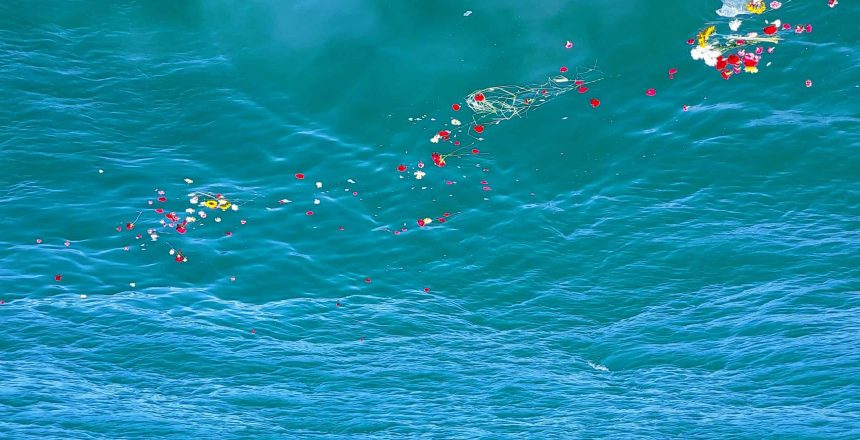
For the ceremony itself, loose petals often work even better than a full arrangement. Families can hold them, release them at the moment of scattering, and watch them spread across the surface of the water. There’s something about that visual — color against the gray-blue Atlantic — that stays with people long after the day is over. It’s participatory in a way that a spray on an easel simply isn’t.
If you want the visual weight of a full arrangement during the service aboard the vessel, that’s completely possible too. The arrangement can be displayed on deck during the ceremony, and then individual stems or the entire piece can be released into the water at the end. The key is just making sure every component of it is biodegradable before it goes in.
Flower Wreath for Funeral: What a Floating Wreath Means — and How to Do It Right
A flower wreath for a funeral carries one of the oldest symbols in memorial tradition — the circle, with no beginning and no end, representing eternal life and the continuation of the soul. It’s a form that shows up across cultures and centuries, and it translates to a sea burial ceremony with remarkable power. Watching a wreath float on the open water as the vessel pulls away is one of those moments families describe years later.
But again, the construction matters. A standard funeral wreath is typically built on a foam ring wrapped in plastic sheeting, with wired stems and synthetic ribbon. None of that is ocean-safe. What you want instead is a wreath built on a natural base — grapevine, willow, or moss — with stems secured using natural twine or simply woven in. No foam, no wire, no plastic of any kind.
Flowers that work especially well in a floating wreath include roses, which hold their shape on the water; marigolds, which are lightweight and vivid; and orchids, which have a natural elegance that reads beautifully at sea. Sunflowers are striking if you want something bold — their yellow faces against open water are hard to forget.
For families throughout Queens County, this is also where cultural tradition and ocean ceremony can meet in a genuinely meaningful way. A family from Flushing honoring Chinese funeral customs might choose white chrysanthemums, which are the traditional mourning flower in Chinese culture and are fully biodegradable. A family from Richmond Hill or South Ozone Park with South Asian roots might choose loose marigold petals — saffron and orange — scattered directly onto the water alongside the ashes, which is both culturally resonant and completely EPA-compliant. Families from Astoria with Greek Orthodox traditions often gravitate toward white lilies and white roses, which pair naturally with the kind of dignified, simple ceremony that a sea burial tends to be.
The wreath doesn’t have to be elaborate to be meaningful. Sometimes a simple ring of roses, woven together with cotton twine and released onto the water, says everything that needs to be said.
How to Coordinate Flowers Between a Funeral Home and a Sea Burial Ceremony
Most families who choose a sea burial have already had some form of traditional service — a viewing, a religious ceremony, a gathering at a funeral home. The flowers from that service and the flowers for the ocean ceremony don’t have to be two completely separate things, but they do need to be planned with both settings in mind.
The challenge is that funeral homes and florists default to what they know — foam-based arrangements that look beautiful indoors but can’t go in the water. If you’re planning both a traditional service and a sea burial, the conversation with your florist needs to happen early, and it needs to cover both events at once.
We work alongside families throughout Queens County through every step of this process, and we’re used to bridging the gap between what a funeral home provides and what a sea ceremony requires. You don’t have to navigate that alone.
What to Tell Your Queens County Florist Before Ordering Funeral Flowers for a Sea Burial
Queens County has no shortage of florists who work with funeral homes — Marine Florists, Georgewood Florist, Jackson Heights Garden Center, and Northern Boulevard Florist in Woodside are among those who regularly coordinate with local funeral services. The issue isn’t access to florists; it’s knowing what to ask for.
When you call, lead with the context: you’re planning a sea burial, and any flowers that will go into the water must be fully biodegradable. Then be specific. Ask them to use no floral foam — sometimes called oasis — and no wire stems. Ask for natural twine or cotton string instead of synthetic ribbon. If they’re building a wreath, ask for a natural base like grapevine or willow rather than a foam ring. Most experienced florists can work within these parameters without any problem; they just need to know upfront.
It’s also worth asking whether they’ve done this before. A florist who has worked with sea burial families will understand immediately. One who hasn’t may need a moment to think through their process, but that’s not a dealbreaker — it just means you’ll want to confirm the materials before the arrangement is completed.
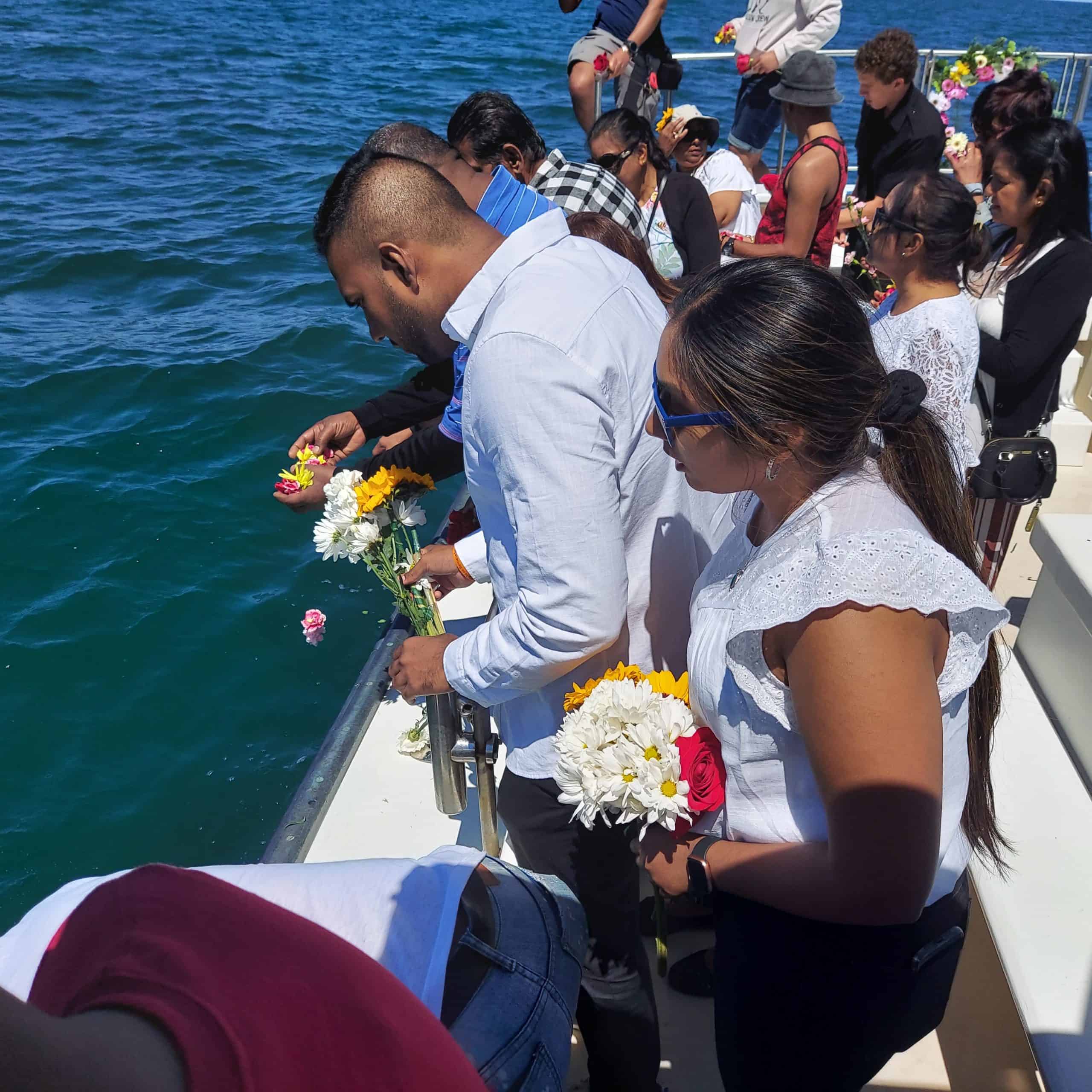
If you’re planning to bring a full arrangement aboard our vessel, the Seaspray, during the ceremony, there’s no restriction on having a foam-based display on deck as long as it’s not going into the water. Families sometimes bring a traditional arrangement for the service itself and then release loose stems or petals at the moment of scattering. That’s a practical and meaningful way to honor both settings without compromising either.
One more thing worth knowing: the Seaspray sits low in the water, which means releasing flowers directly from the deck is easy and natural. You’re not leaning over a high railing or passing things awkwardly to a crew member. The moment of release — whether it’s petals, a wreath, or individual stems — can happen at the exact same time as the ash scattering, which is often when families want it most.
Do All Funeral Flowers Have to Be White for a Sea Burial?
This comes up more than you’d expect, and the answer is no — there’s no color requirement for flowers at a sea burial. White is traditional in many Western funeral contexts, and it carries its own quiet dignity. But it’s not a rule, and for many families in Queens County, it’s not the most meaningful choice either.
Queens County is one of the most diverse counties in the country — nearly half of all residents were born outside the United States, and the county is home to communities from dozens of countries, each with their own relationship to color, flowers, and grief. A page that only talks about white lilies would be missing most of the people it’s trying to reach.
Vibrant colors often work better at sea than people expect. Yellow sunflowers, orange marigolds, deep pink roses, and purple orchids all stand out beautifully against the open water. If anything, bright colors create a more striking visual moment at the point of release — which is often the image families carry with them long after the ceremony ends.
For families with Caribbean roots in Jamaica or St. Albans, bold tropical flowers are a natural fit and can be sourced through florists familiar with those traditions. For Korean families in Flushing or Bayside, yellow chrysanthemums hold specific cultural meaning and are fully appropriate. For families from Latin American communities in Jackson Heights or Corona, vibrant mixed arrangements — the kind that show up at quinceañeras and celebrations as much as at funerals — can be adapted for a sea ceremony with nothing more than a change in base materials.
The only real constraint is biodegradability. Within that, the flowers should reflect the person being honored and the family doing the honoring — not a generic idea of what a funeral is supposed to look like. That’s true of the whole ceremony, and it’s true of the flowers too. Each life is different. The tribute should be too.
Planning a Sea Burial in Queens County, NY: What to Know Before You Call a Florist
The short version: almost any flower you’d choose for a traditional funeral service can come with you to a sea burial. Roses, lilies, orchids, sunflowers, chrysanthemums, marigolds — all of them work. What needs to change is how they’re put together. No foam, no wire, no synthetic materials. Tell your florist that upfront, and most of the complexity disappears.
If you’re also navigating a traditional service at a funeral home alongside a sea ceremony, plan both at once so your florist can build arrangements that serve either setting — or create something specifically designed for the water.
And if you’re not sure where to start, that’s exactly the kind of question we’re used to answering. We work with families throughout Queens County, Nassau, and Suffolk County to make sure every part of the ceremony — including the flowers — feels right. Reach out to us, and we’ll walk you through it.